Featured

Post #1: archive.org, Joust

Joust

Joust is a fun two-player arcade game. How is it on archive.org?

This weekend, I played Joust for free on archive.org. When I got it to start, I pressed the “insert coin” button five times because I’m a baller when the money involved is imaginary. I was making it hail on that virtual arcade machine. In a physical arcade, I tend to save my quarters for racing my friends in Initial D, or doing battle in Mortal Kombat.
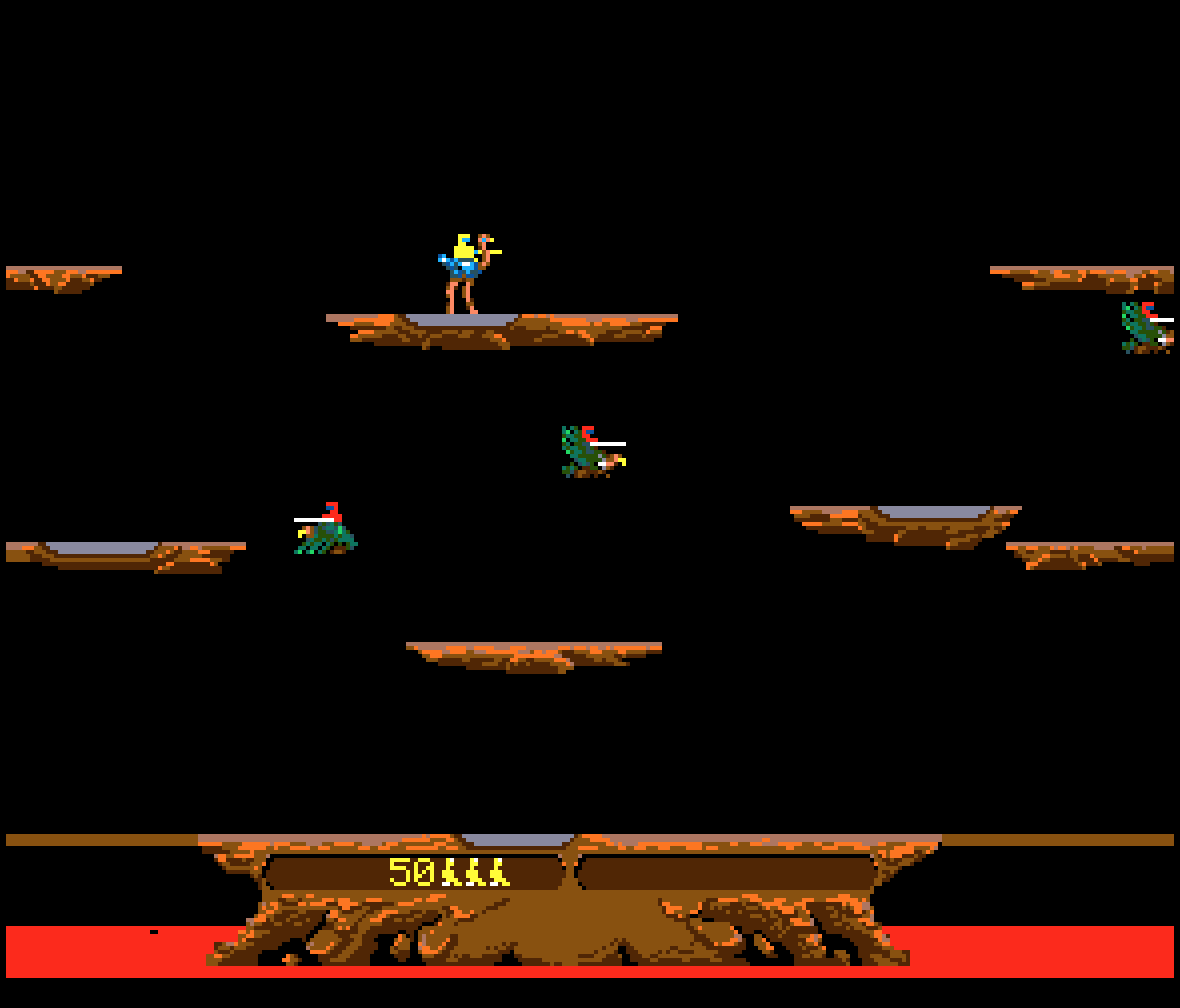
I was already familiar with the rules from the first time I played Joust, and from reading about the epic Joust battle taken by Parzival in the book, Ready Player One. Arrow keys move your knight who rides upon a flying ostrich in the left or right direction, while the ctrl key is pressed many times to “flap” which increases height. Gravity is present and it pulls your knight back down onto the platforms. The goal is to crash your knight into the other knights from above to slay them and stomp on their eggs. Preferably to the dismay of your friend who controls the other knight.

I found that the version on archive.org did not control as I had expected. I was not able to change direction midair, and the movement felt sticky. I found myself more than once wondering why I was not moving, and found I had to let go and press the arrow key again instead of holding it. I died a lot and found it to be very difficult.
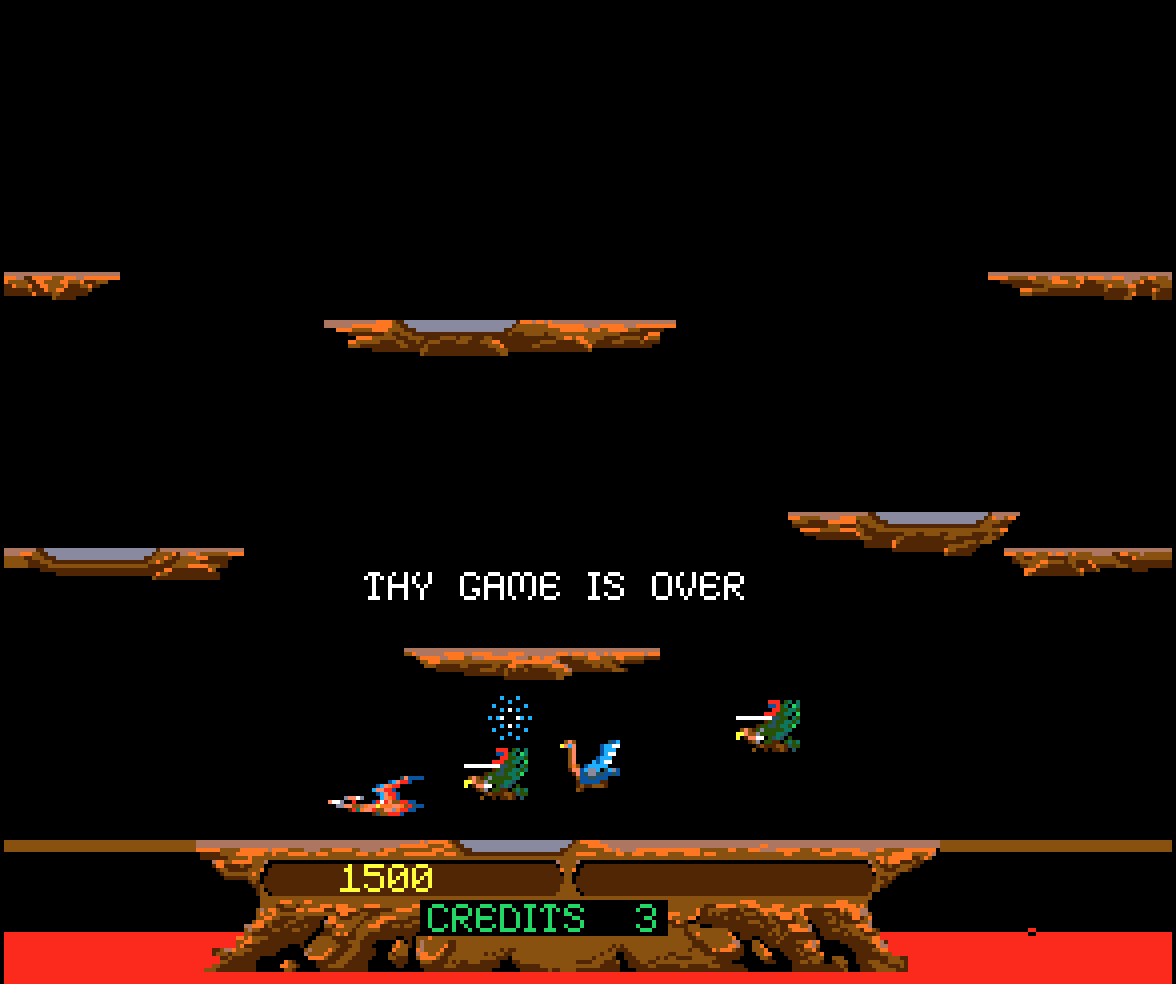
When I saw this game was available, I knew I had to play it, because I have a very fond memory of playing this game on original hardware. It was during a Super Soul Bros concert at Cafe Stritch in downtown San Jose in 2016. My date (now girlfriend) and I went there to take part in a game themed bar crawl, and they set up a few arcade machines in the back of Stritch to draw in customers. My date and I had a ton of fun jousting with each other and dancing to upbeat music.

This emulation available on archive.org certainly looks the part. I cannot attest that it feels the part as I am now questioning my memory of how the original played, though I do not remember it being so sticky. However, there are some glaring differences. The first being that the keyboard of the macbook I played it was never intended to replace the colorful joysticks and shiny buttons of a Williams Electronics arcade cabinet. The games I am used to playing on a laptop keyboard are old flash games, because I would save the serious gaming for my desktop PC. For this reason, this emulation of Joust felt more like I was on addictinggames.com (RIP), than if I was back in time on an arcade cabinet in the 80’s.

The second difference is that, when I played the game, and indeed when I was writing this review, I was at home, in the dark, and I was absent-mindedly watching Scrubs in the background. This is a very different scene to Cafe Stritch. Stritch is a bustling jazz club on one of San Jose’s busiest night life streets. The posters on the red brick walls are all of famous jazz musicians who have played there. Somebody is wailing on the piano while people joyously chat and bob their heads to the music. Servers walk by with plates of baked mac and cheese whose smell entices you to consider parting with a few dollars. The drink in your hand is cold, the lighting is warm, and the colorful glow of an arcade cabinet beckons you and your date. You try it out, and, while you are still learning the controls, she mops the floor with you. Her triumphant squeal is cute, but that doesn’t change the fact that you’ve been hustled. You’re not about to let her defeat you again.

That’s what is different about emulation. The circumstance behind playing the game. I played this game with cold appraisal on my laptop computer. Any critique I had of the game would not be fair considering the developer’s intention. This game is made to be played with friends on a night out, in an exciting atmosphere. And it is an incredibly fun experience. So while you can play this game for free online, it is nowhere near the experience you will have if you play this game out in the wild.
Course Reflection

Over this course, I made 3 full games. A card game, a side-scrolling platformer, and a side-scrolling shooter. During this course, I learned much about how to talk about games, compare games of different genre, and learn why people go to games.

I also learned how games can be beneficial to health, increase focus and empower eyesight, and teach controversial things.

Most interesting for me, was learning how to compare games of different genres. Another great thing to learn was Unity. I learned a lot but I feel like I bit off more than I could chew.

I read, wrote, played, and designed games.

Blog Post 8: Final Project

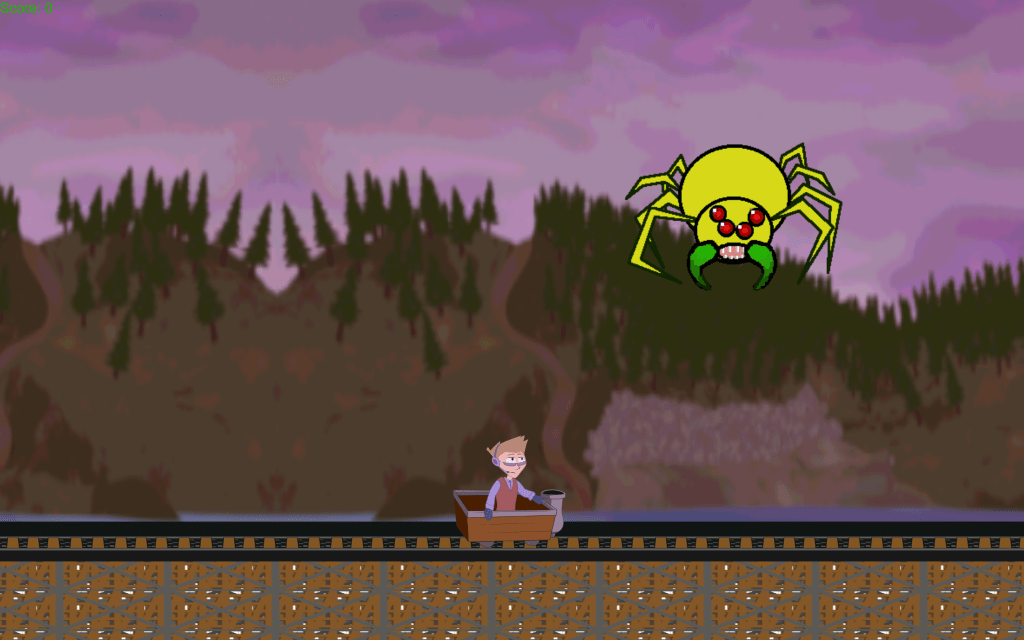
In class this week, we showed our first draft of our final games. My group is Emily, Johnny, and Andy all as artists, and myself stepping up to take on the role of programmer. Our game’s running title is Spidercoaster. It features characters and story from a web series (I think) that Johnny and his friends make. I wasn’t really that interested in watching it. But Johnny had a type of game in mind and he was really enthusiastic so we agreed to make it.

The game is a side-scrolling shooter where you control a man on an old wooden rollercoaster in the mountains. Your character is always moving from the left to the right at breakneck speed, but you can choose to slow him down and move to the left of the screen, and speed up by going to the right of the screen.

All the while this is happening, you make your character shoot at monstrous spiders that rain from the sky. If you make it to the end without being hit, you keep your score and are sent back to the level select screen.

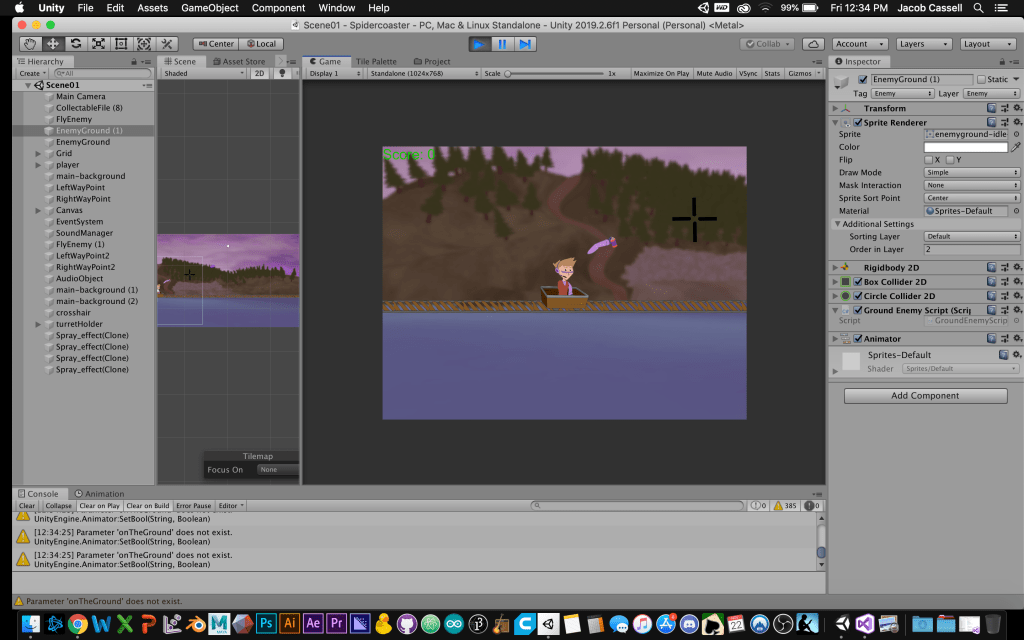
Our initial prototype has had a lot of issues with shooting. You leave his arm behind somewhat comically when you accelerate the roller coaster car. Character control, I’d say is the main hurdle. Once we get that down solid, it will be a much better experience.

Post 7: GPS Game

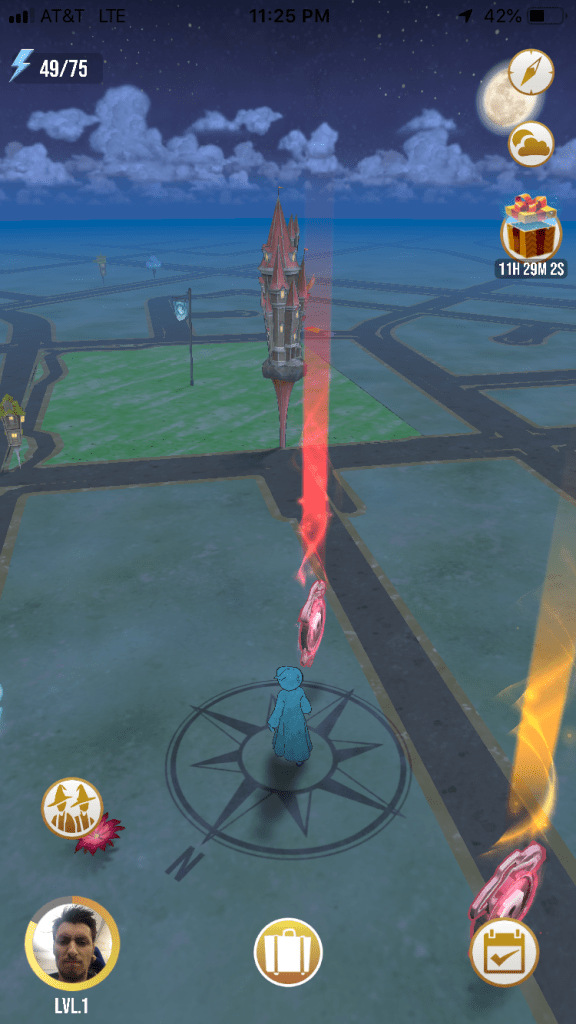
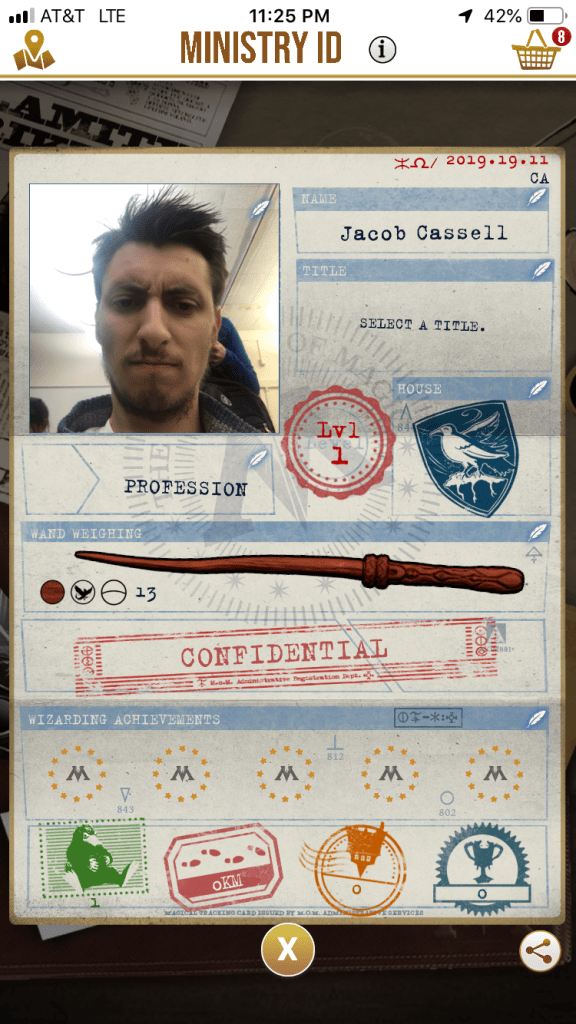
This week, we played a mobile game called Harry Potter: Wizards Unite. This game is an augmented reality game that follows a similar sort of style as other games like Ingress and Pokemon Go. That is to say, it had a lot of spots that you had to walk to to access aspects of gameplay. And parts of the gameplay happened over top of the world seen by your phone camera so that it looks like Hagrid is standing right in front of you.

I was twelve days from turning seven years old when the first Harry Potter movie came out. I was surrounded by Harry Potter everywhere I went as a kid. There was a time I was not a fan, but I think that was due to fatigue and me being an angsty teenager.

So I enjoyed hearing John Williams’ musical score again when I booted up this game, and it was nice to see familiar characters and I felt the humor of the game was in line with the rest of J.K. Rowling’s vision.

I was bummed that it did not offer a chance to sign in to your Pottermore account so you did not have to get sorted or register a wand or a patronus or anything like that. And I felt the sorting and creating a character part was a little lackluster considering that’s one of the more fun parts of being a fan of Harry Potter. A lot of people take those quizzes that determine what merch to buy and what your imaginary aspects of customization are. So to see it as basically a dropdown menu was a little disheartening.

That being said the game is fine really, if you’re the type to enjoy that sort of thing. I experienced a lot of the same things I did when Pokemon go was new. That one had houses, too, only they were called teams. I remember people being just as fervent about their Pokemon team identification as their Harry Potter house back when J.K. Rowling hadn’t written all the books yet.

Having a lot of people all around you while you play certainly makes things nicer. Everyone is able to participate and see what is happening on your device which adds more authenticity than making Hagrid appear in miniature on your desk in class. That would be a sight if it happened for real.

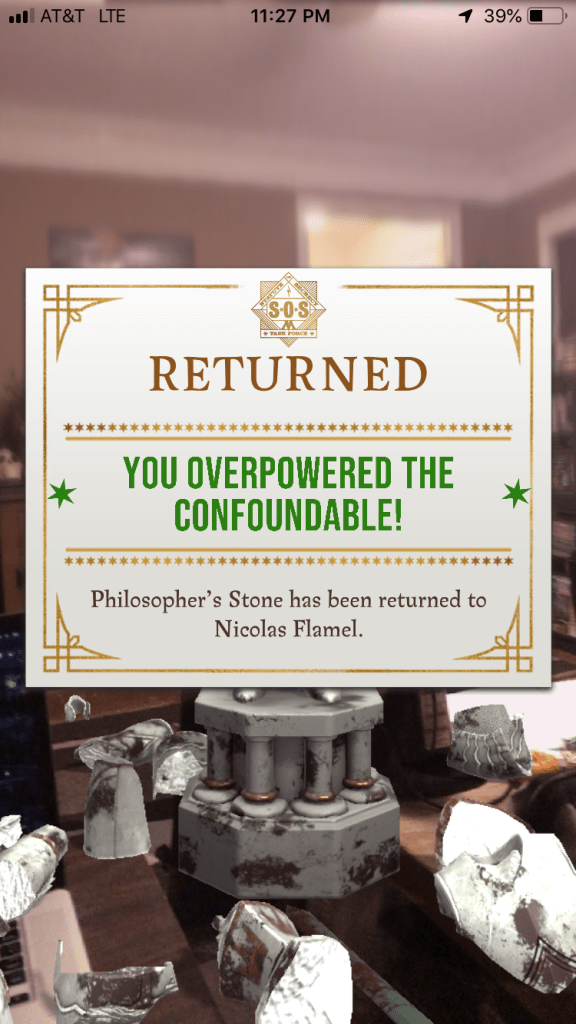
I didn’t like, however, and others noticed as well, how there were some inaccuracies. I literally got the Philosopher’s Stone and a Time Turner right away. Both objects of immeasurable value, and both have been destroyed in the canon.

The game was charming though and it felt nice to be a part of a group seeing something fantastical in real life.

Post #6: Game Prototype

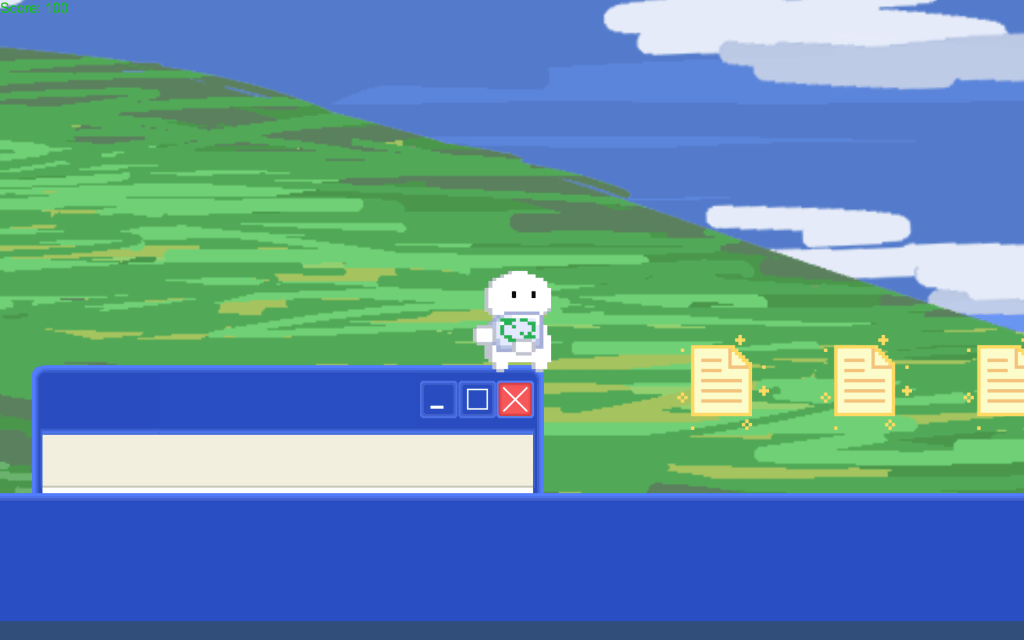
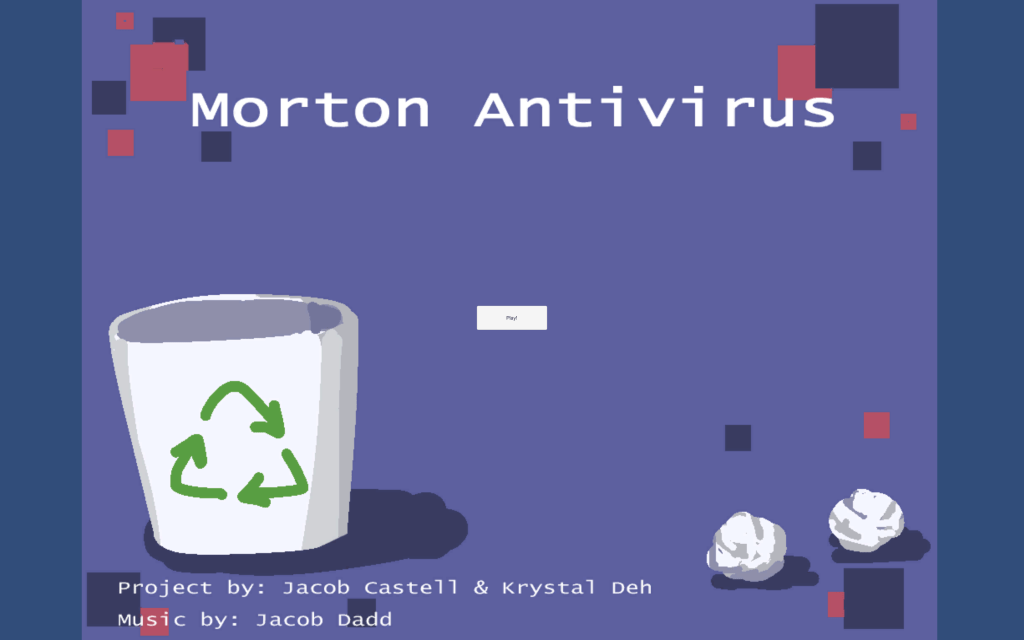
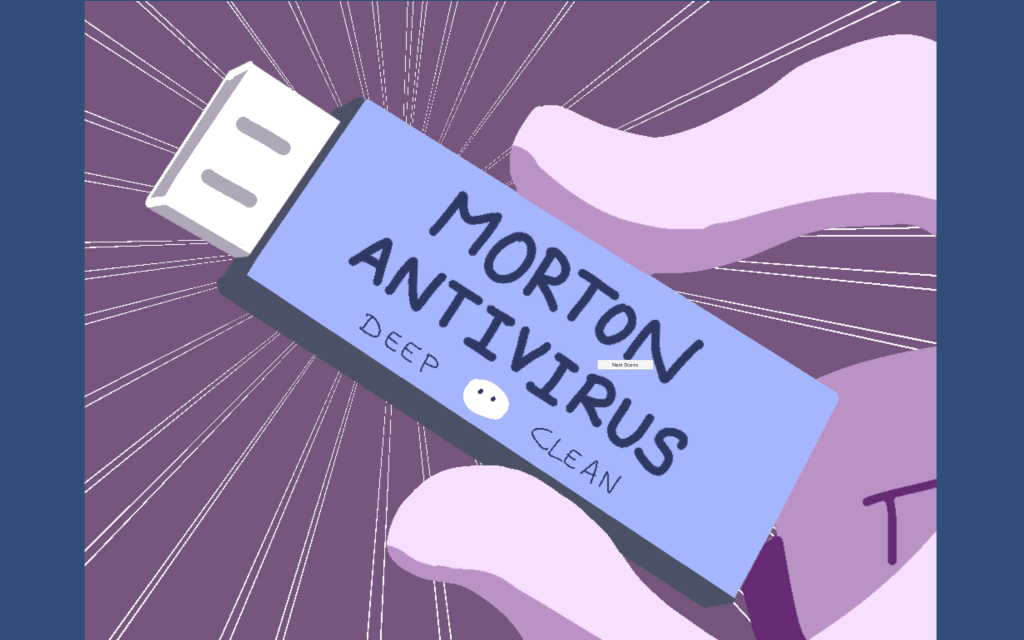
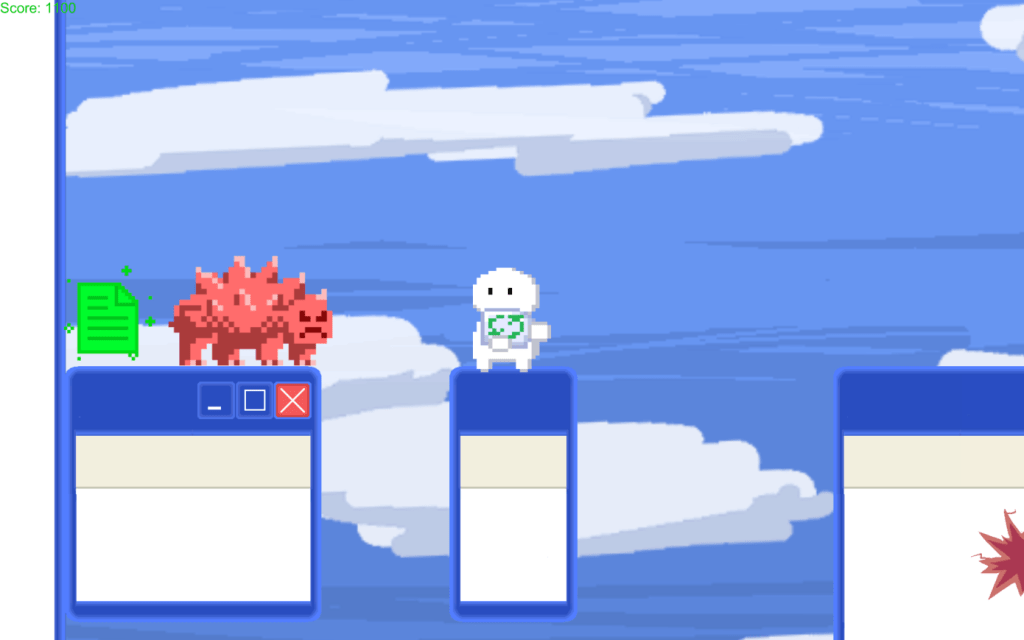
This week, we finished our prototypes of our games. My group’s game, Morton Antivirus, is now actually playable. This game’s incredibly charming art direction was designed by Krystal, and was programmed by me, Jacob. The level music was commissioned by local digital music artist and friend, Jacob Dadd.

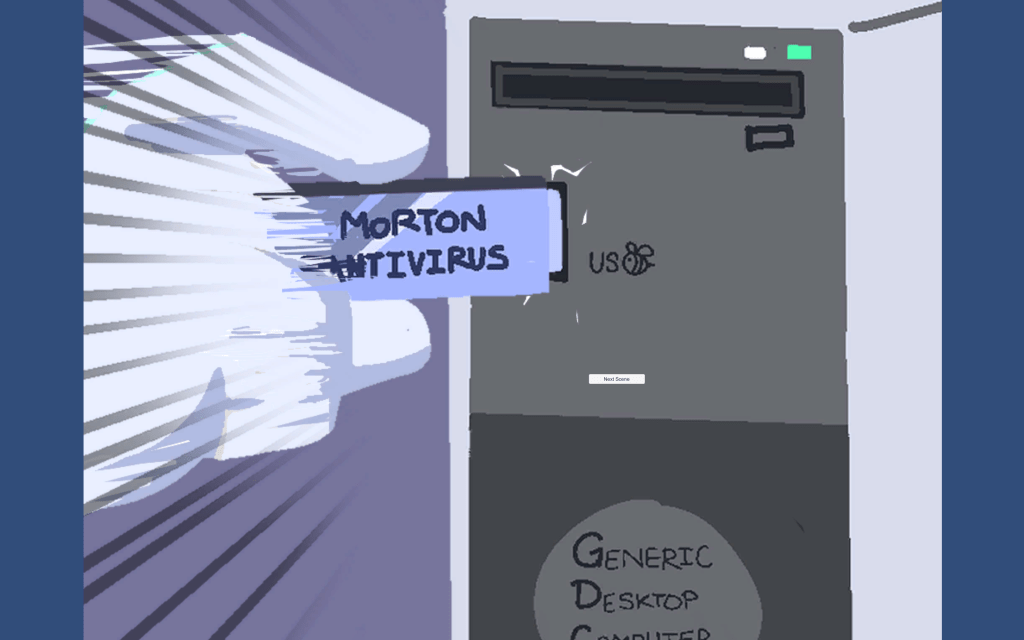
First, to play the game, you click through on the play button on the main menu. Then, push the buttons that progress to the next cutscene as you learn the story. A person has gotten a bunch of awful viruses on his Generic brand PC. This person needs a heroic antivirus software to come to their rescue. Never fear, Morton Antivirus is here!

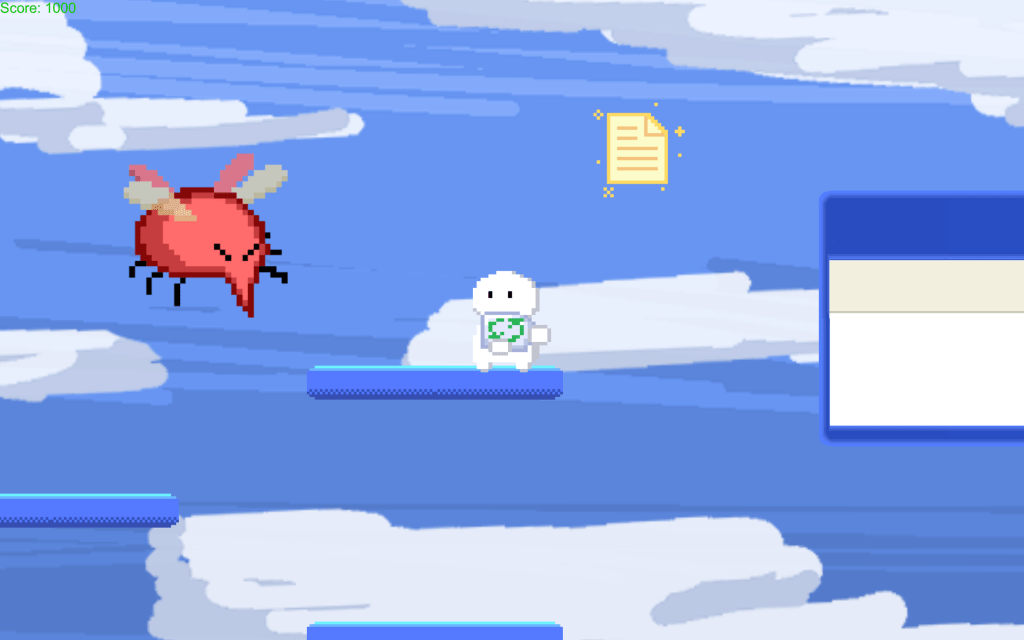
Then it puts you into the only level. You press the “a” key to move Morton to the left, the “d” key to move Morton to the right, spacebar to jump, and the “j” key to shoot lethal paper balls from his recycle bin.

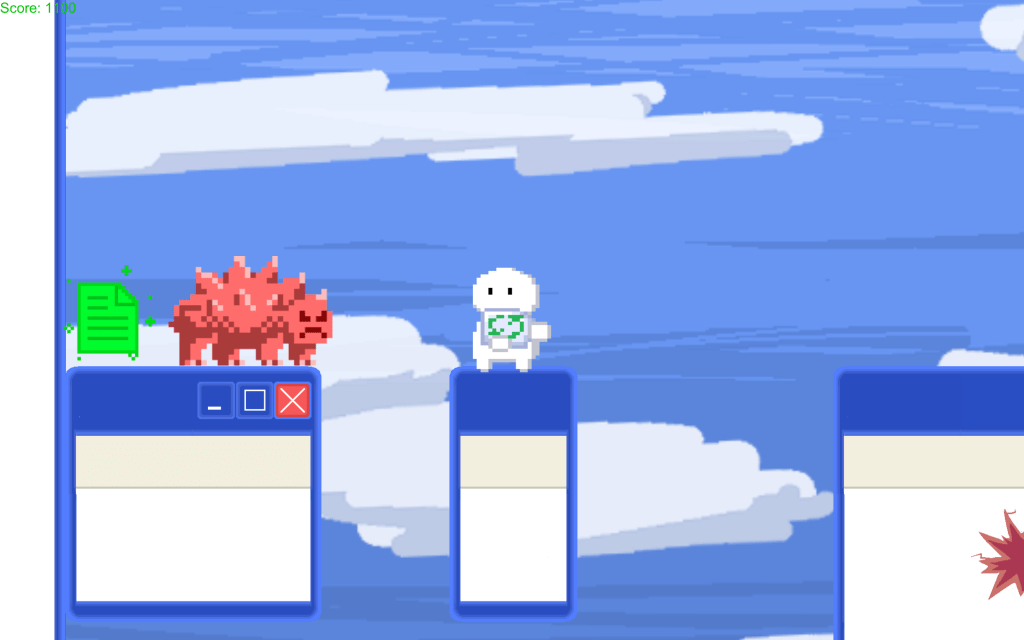
The goal is to find the green file (system 32), and save the day. On the way, Morton collects other files to increase the score, and encounters dangerous viruses that kill him on contact. It is your job to bring Morton to system 32 while collecting as many files and killing as many dangerous viruses as you can along the way. Once you touch system 32, the game ends and returns to the main menu.

There are a few known bugs. Morton sticks to the walls and platforms if you hold the left or right button, which makes a couple of the jumps trickier than they would otherwise be. The buttons to progress the cutscenes can end up hidden behind the borders of the screen if the screen being used is in a small resolution size, which is common on some Macbooks. The score also keeps going up with each play through and never resets. Which is either a bug or a feature, depending on how you look at it.

As it exists now, the game is a proof of concept. It is charming, it can be completed, it has a cutscene, bullets hurt enemies, if the player character dies, you can restart without going back to the main menu. This translates to a complete and mildly fun experience with some very minor snags, even if it is short.

Without any new features being added to it, the game can have multiple levels with different shapes to make more of a “game” than a single level experience. Different weaponry and enemy shooting would be nice as well and add variety and danger. The most unique thing that I see this turning into is in the realm of bosses. I think a weapon that allows the mouse to close the windows and delete the platforms would be really interesting as an ability in a boss battle. It’s all there though, the whole framework is there, it can absolutely be added onto.

Blog Post #5, First Playable Demo

This week, we were put to the test to make a two-dimensional game with a partner. One of us would make the code work, the other would be in charge of art design. I volunteered to be the one in charge of the code, since I’m a fan of jumping headfirst into hard projects. I was partnered with artist, Krystal Deh, and we decided to make a 2D platformer.

Our game is called Morton Antivirus. The story goes that somebody got their computer infected with ransomware, so they put in a floppy with our antivirus hero on it to save the day! His name is Morton and he is fat, cute, and kickass, and he will run around your computer saving your documents and killing the nasty viruses.

So we made an incredibly short gameplay alpha test. It was missing some core mechanics but it was something that could be started and controlled and had some items. That being said, it was pretty barebones because of the time deadline. But we still got some killer feedback from our testers.

They loved the look. The cuteness combined with the retro Windows XP/AOL Instant Messenger vibe was an instant success. Everyone knew what it was supposed to be and fell in love with our little Michelin man, Morton, right away. All credit to Krystal, she’s an excellent character designer.

Things that they didn’t like were that there was no jumping yet. This was to be expected, It was my first time doing something like this, so I had trouble making it work before the deadline. But something that was controversial was that you could stick to the wall as you were falling if you held down the right or left arrow into the wall. I thought this was very fun, but it got mixed reviews. I think that I will try to keep it in as it was genuinely a 50/50 split and Krystal and I both found it to be fun. But, if it doesn’t end up working out with the jump feature, I won’t keep it in.

Based on the feedback we got, the art was a 10/10, the mechanics were lacking, so we are going to keep adding as many features as we can, and also push the cuteness to the next level. We are both excited and we’ve got a good work dynamic.

Post #4 Video Game Lab

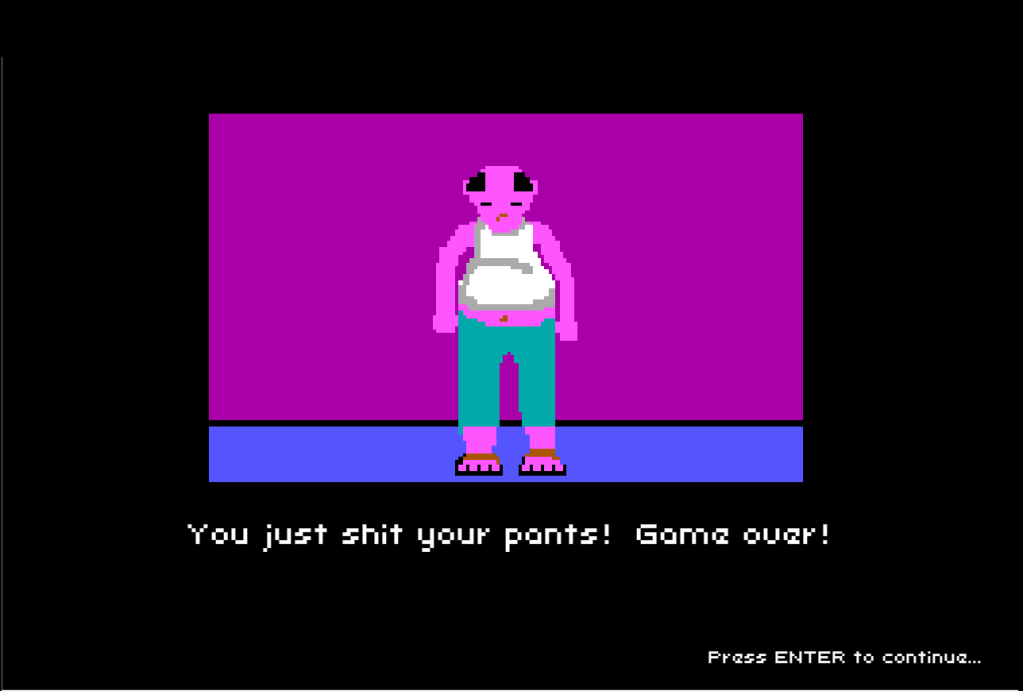
This week I played some simple free video games with a friend, Antony Bui. Some games of note that we played were “This is the Only Level,” “Don’t Shit Your Pants,” and “Salvation,” the last one being a student-made game.

This is the Only Level

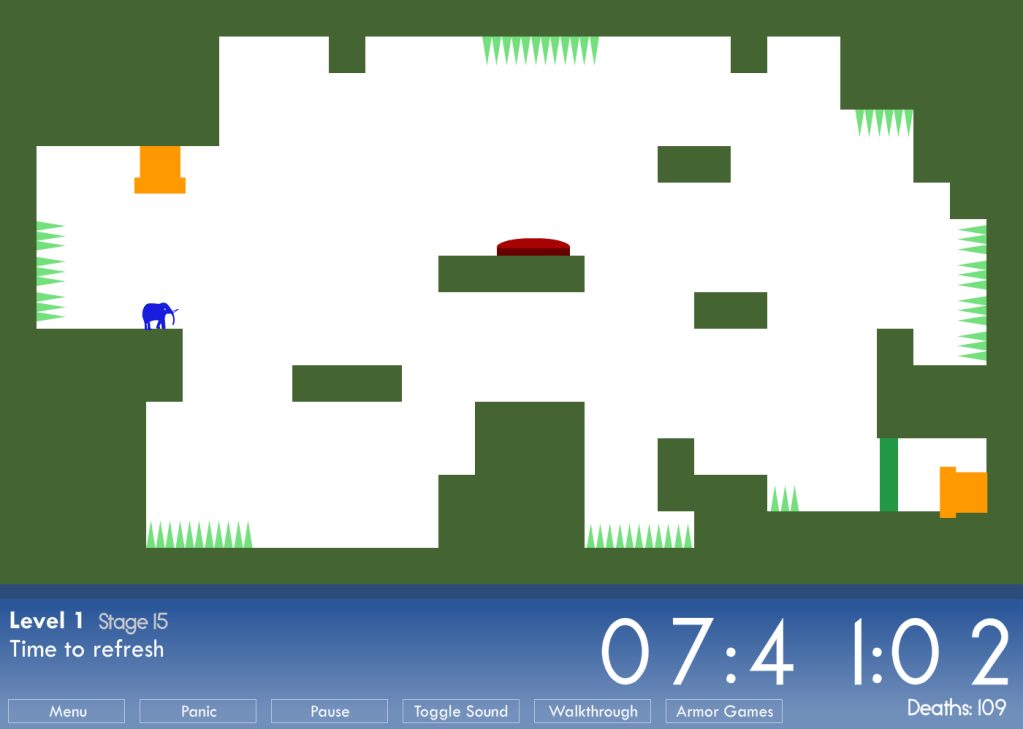
“This is the Only Level” was incredibly difficult because, while the traditional side-scrolling puzzle platforming level stayed the same with each pass, the control scheme and meaning of obstacles changed with each iteration.

Once you beat a few levels you began to learn what to expect, but the levels get brutally difficult after only a few levels have been beaten. Some of them place instant death tiles on the ground, which are easily avoided after dying once to them, but this is just the tip of the iceberg. The farthest we got was stage 15 where we could no longer figure out how to beat the level.

The variety was specifically mostly in the control scheme with a little in the elements of the environment. It seemed like it was designed to make the player to consider new ideas for games by making a lot of iterations on a classic format. It demonstrates that it is possible to deviate from the same game formats in infinitely many ways, so there is no excuse to keep making the same tired formats over and over again. I found it to be very instructive and incredibly thought-provoking, but I did not find it to be a very fun game. It was both frustrating and educational.

Don’t Shit Your Pants

The next game of interest we played was “Don’t Shit Your Pants.” Maybe this is the 12 year old in me speaking but I found it to be both incredibly fun and incredibly funny. The concept is that you control a guy who is going to poo himself in 30 seconds and you have to type incredibly specific commands as in a text-based adventure like Zork, just to get him to open the door, pull down his pants, and squeeze out a turd that is coming in just a few seconds whether you’re ready or not.

The stakes are high, and failure is a reward in and of itself. There are achievements for finding each different outcome, which encourages jumping right back in for another fast paced attempt. For me the best part is how intricate it is. You can command him to poop in his pants simply by typing “shit.” You can command him to poo on the floor, fart to give yourself more time, take gas pills, or just watch as his eventual doom comes.

Having to figure out how to control him to do what you want, under a time limit, combined with exploring each and every thing you can do with immediate and sometimes devastating responses, and collectible achievements to mark what you’ve discovered makes this game actually sound very similar to “This is the Only Level” on paper. Why then is this game so much more fun?

There is virtually no connection with the mechanics of the two games. They are both played in entirely different ways. They also have completely different narratives. The objective and indeed the entire story of “This is the Only Level” is to get to the end. “Don’t Shit Your Pants” has a story and it has a vastly different tone than the other game. What then is similar about these two games?

The two games are both concerned with the same aesthetics. You go to these games to satisfy nearly the same itches. The games both feature a Challenge aesthetic where the game is an obstacle course with correct moves and incorrect moves. They also both feature the Discovery aesthetic, first in finding out if you really can poop his pants, and then discovering the control schemes of each one. You learn new ways of playing games, through trial and error and you have the satisfaction of having completed each one as a completely fresh experience.

Salvation

The last game of note that we played was “Salvation.” This one I watched him play first and then He watched me.

“Salvation” is a student-made game of the side-scrolling puzzle platformer genre. This game is actually very impressive for a student made game. It was probably made under a deadline and the student probably had to make some compromises on their original vision because of this, so I feel that is important to take into consideration when reviewing this game.

It suffers from a problem that a lot of side-scrolling games have. Your character can outrun the screen. This is especially true when jumping. The problem is exacerbated by the fact that enemies kill you in one hit. So if your character is all the way to the right of the screen, you can’t see a monster coming and you will sometimes die right away without knowing what happened, unless you’ve played the level before and have memorized the position of the enemies.

Watching Antony play, I kept wondering why he was jumping in a specific way, or why he chose to jump so fast off screen. Playing myself, I found that these were not choices. It was actually very hard to avoid going off screen. I also wondered why he couldn’t juke the enemies and outrun them, but when I played I found that they stick to your character like glue. I just kept saying in my head, “I could have made that jump better” or “I could have seen that coming and avoided that.” But when I played I found I was falling into the same traps and making the same mistakes.

I suppose that means that the difference is that, as a watcher, you can take in more of the details since you don’t have to worry about survival. As a player, your mindset is different. You are just trying to survive and find the end of the puzzle.

Post #3 Scunch, A Card Game

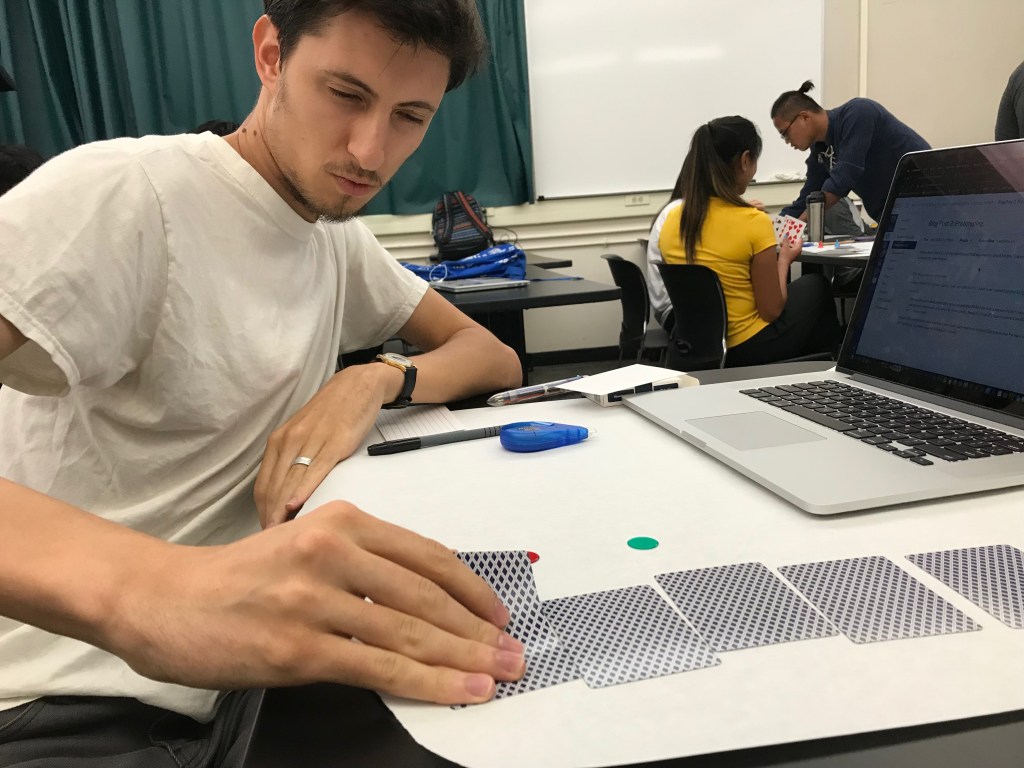
Two weeks ago, I was inspired to create a card game. I joined with another enthusiastic student who wishes to make games and we set to work. Afterwards, we split up to take the game in completely different directions.

My take on it is called Scunch simply because it’s fun to say.

The game is a take on Poker by somebody who doesn’t like playing Poker, but does like friendly competition between friends. It is typically played by two people, though it can be upgraded to four.

How is it supposed to play?

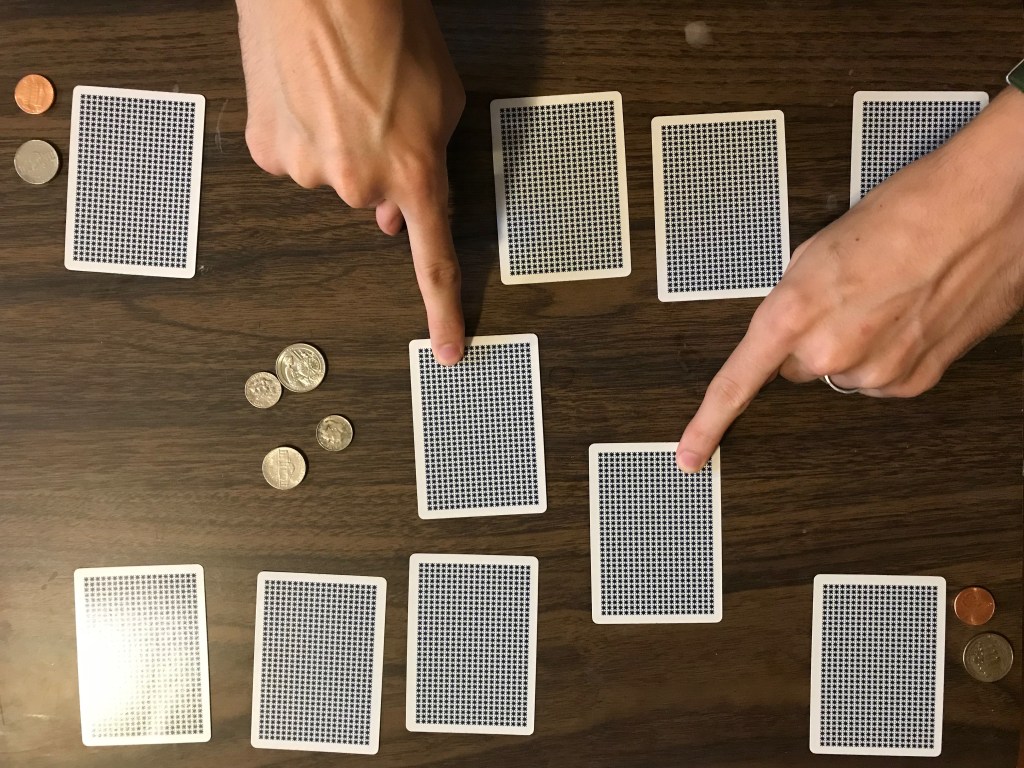
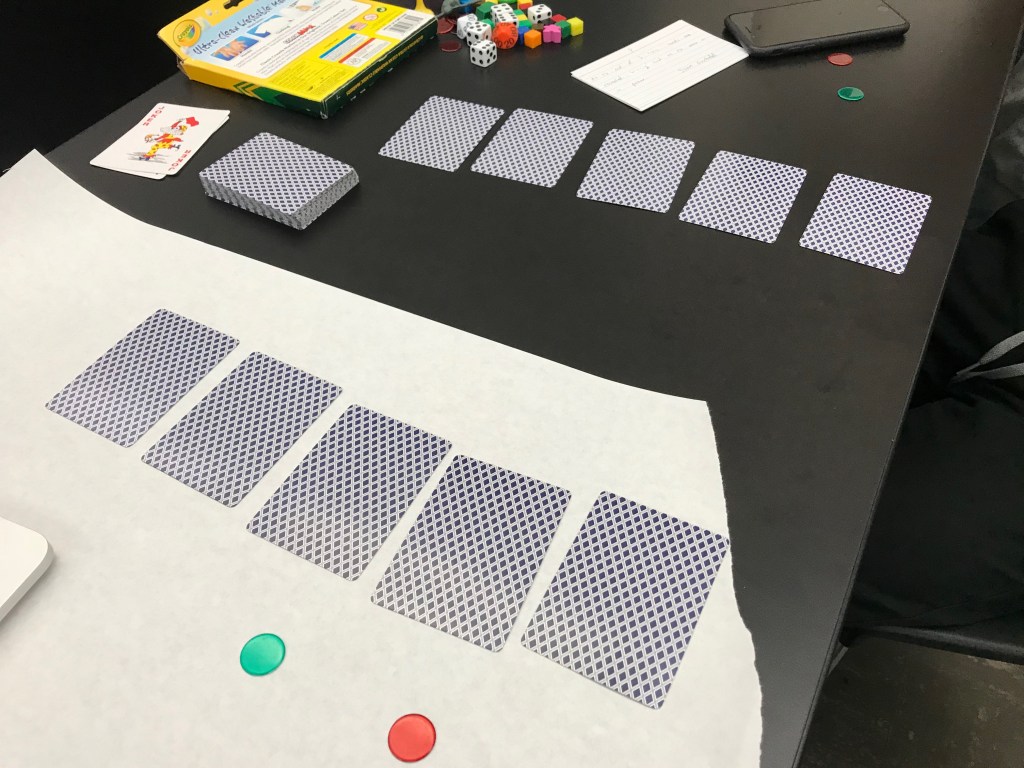
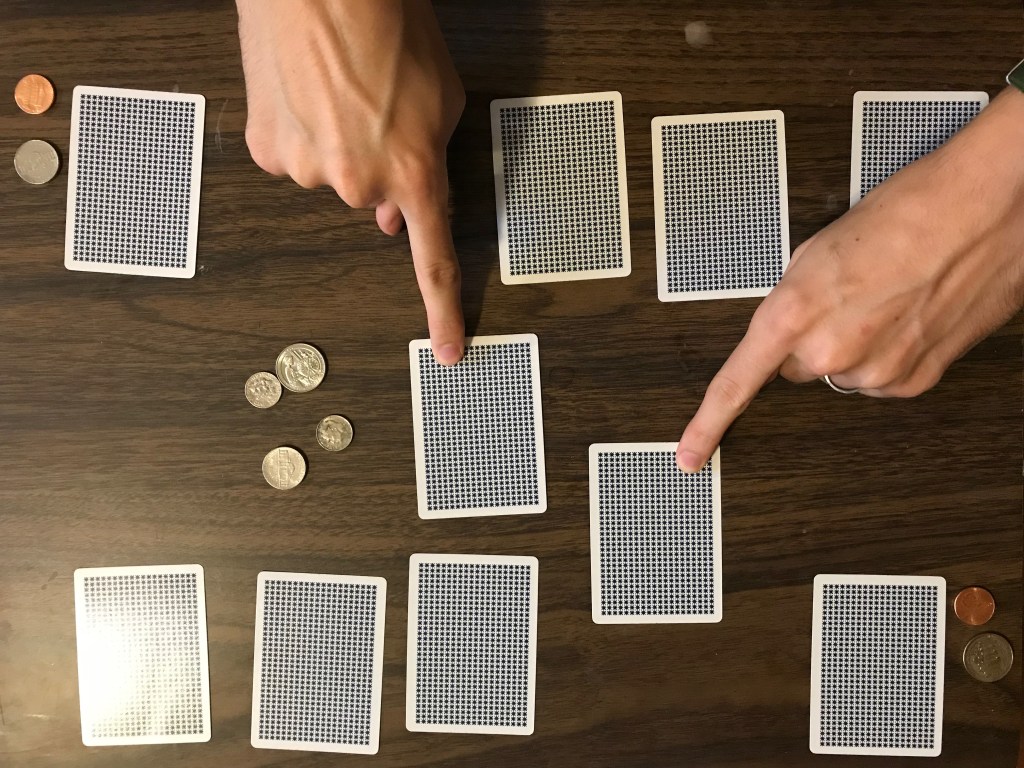
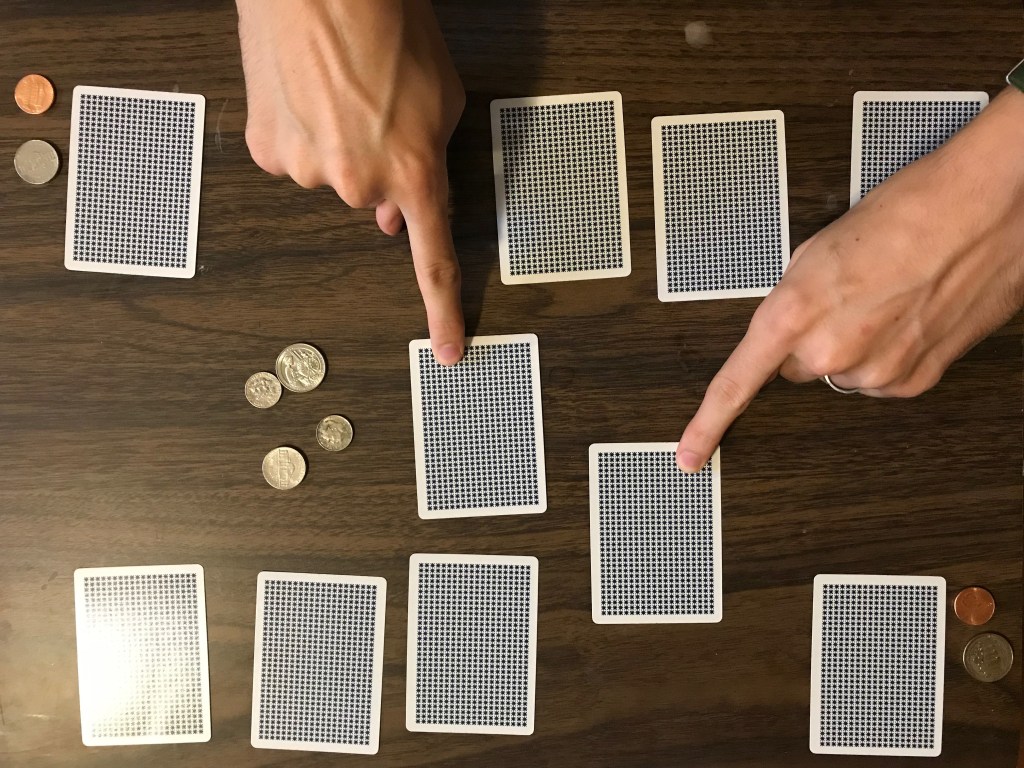
First, each player pays the ante, one Ante Token (commonly, one penny), into the pot, this is the wager that you are going to win. Then, from a standard shuffled deck, each player is dealt 3 cards whose positions on the table do not change, unless a player makes a move.

This is the core mechanic. Players choose a card to trade with a card from their opponent’s hand, in order to learn what cards are in play, so that they may make their hand better by the end of the final round. Once both players have made a move, then the round is over and a new card is dealt to each player’s hand.

Once the second round is over, a fifth card is dealt, for the final round. Once 3 rounds have completed, players reveal their hands, and Poker rules dictate which hand wins the pot.

Instead of betting as in normal poker, the players may wager larger value tokens to perform special actions in the place of their trade move. The Sight Token (commonly a nickel) is wagered and the player may see an opponent’s card without trading. The Shuffle Token (a nickel) is wagered to shuffle your hand so that your opponent may forget the positions of your cards. And the Discard Token (a quarter) is used to remove either yours or your opponent’s card from play, to be replaced from the deck.

Scunch is also pretty fun when played with all 5 cards dealt right away and only the Shuffle and Discard Tokens in play. This is called Scunch Lite.

But how has it been played?

Scunch Lite is the original form the game took. When I played with my co-creator, we started it like this:

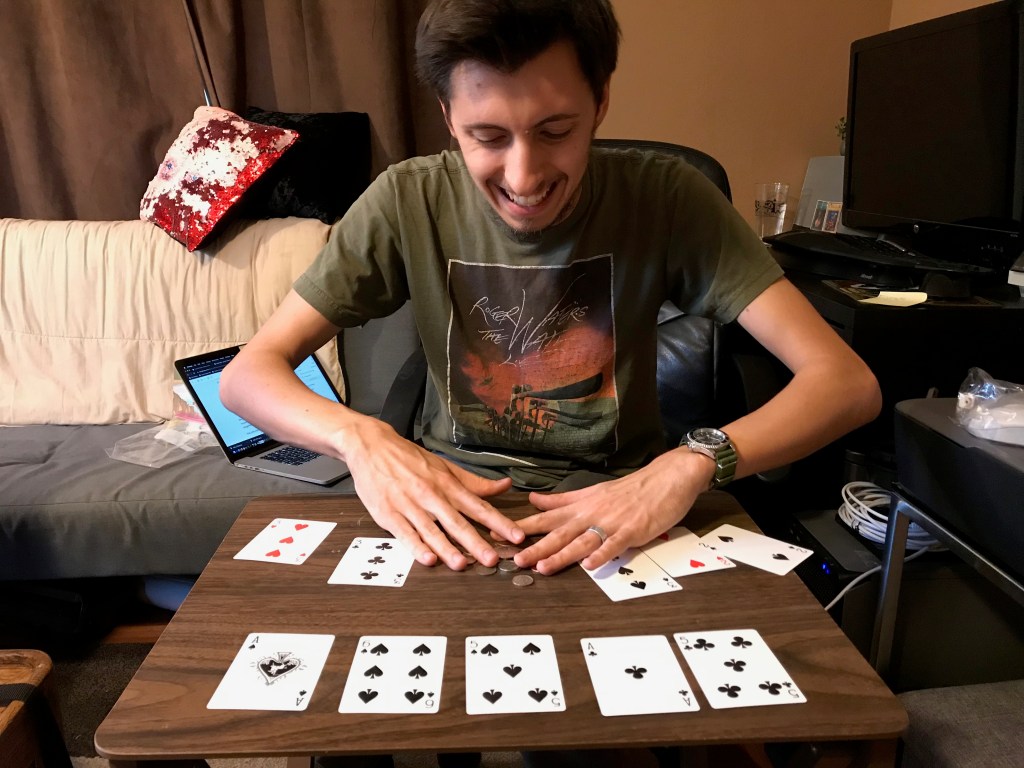
Both players were dealt 5 cards face down and given a discard token and a shuffle token. We looked at our cards and returned them to their original positions. I was dealt a K, 7, 9, A, and 10, my opponent was dealt a 7, Q, A, 4, and a second 7. I went first and I traded my 7 for his A. Now I know one card of her hand and he knows one card of mine. His turn, he traded a 4 for my 10, and we know 2 cards in each others’ hand and round 1 is over.

Round 2: Next I traded the 4 I was given for his Q. He gave me back the 4, and he took my K.

Round 3: I spent my Discard Token to discard one of my own cards (the white elephant 4), and I got a 2 in return which doesn’t help me. He traded my 10 back for the A he had given me.

Reveal! He had 3 of a kind, and took my A at the last second so I didn’t have a pair anymore. A crushing defeat!

We were enthralled! We both loved the game we had created right away, even though I had lost, I was thirsty for more. I knew what hands I needed, and I felt like I could build them with the knowledge I was getting.

Scunch Version 2:

This version, I decided to morph the rules slightly to incorporate an additional Token, the Sight Token. This would allow players to learn an opponent’s card without giving them knowledge of one of your cards. But, since it is guaranteed this token will be used right away, I also added an additional Round.

I played this with a fellow game creator in class on Friday and it played out like this.

I was dealt a J, K, 9, 3, 10. My opponent was dealt a 9, J, 4, 5, 4. Round 1: My opponent went first spent their Sight Token to see my 10. I did the same and saw his J.

Round 2: My opponent traded their 5 for my 10, knowing that it was there, and I, knowing where his Jack was, traded my 3 for it.

Round 3: My opponent traded back the 10 for my 5. My turn, I spent my Discard Token to discard his 5 since it seemed he wanted it, and he was given a 5 again from the deck, which I did not know at the time.

Round 4: My opponent traded his 9 for my K, I spent my shuffle Token to essentially skip my turn because I didn’t want to change my hand.

Reveal! I won this time, I had a pair of 9s and a pair of Js, my opponent was going for a strait and did not get it, but his pair of 4s was beaten.

I had a little bit less fun with this one since I was having a bit more trouble remembering the cards and how many rounds had been completed.

Scunch Final Version

After much deliberation, I decided that more than 3 turns became too much to remember for the average person, so I trimmed it down to 3 again and kept the Sight Token, but incorporated another aspect of Texas Hold’em. I decided to deal out 3 cards right away, and deal two more both as a way to ease players into the memory aspect and to mark the rounds. And with the first round meaning less, we didn’t mind if it was used primarily on a Sight Token. And I decided the game would be more interesting if the Tokens functioned as bets as well, which gave incentive to wager Tokens wisely, instead of spend them all in one game.

We both paid the Ante with our Ante Tokens. I was dealt an A, a 3, and a 7, and my opponent was dealt a 3, 2, 2. I went first and I traded my 7 for his 2. His turn, he traded me back the 7 for my 3. I was dealt a 5, and my opponent was dealt an A.

Round 2: I trade my 5 for his new card, the A. He traded the 5 for the 2 back.

Round 3: I was dealt a 5, and my opponent was dealt a 6. I spent my Discard Token to discard my 7 and I got a 3. My opponent traded a 6 for my 3.

Reveal! I had 2 pair, A, 6, 5, A, 5, and my opponent had a full house! 2, 3, 2, 3, 3. My opponent won the Discard Token I wagered as well as the two Ante Tokens.

This one works. This one has the most potential for strategy.

Post #2 Coup, a Session Report

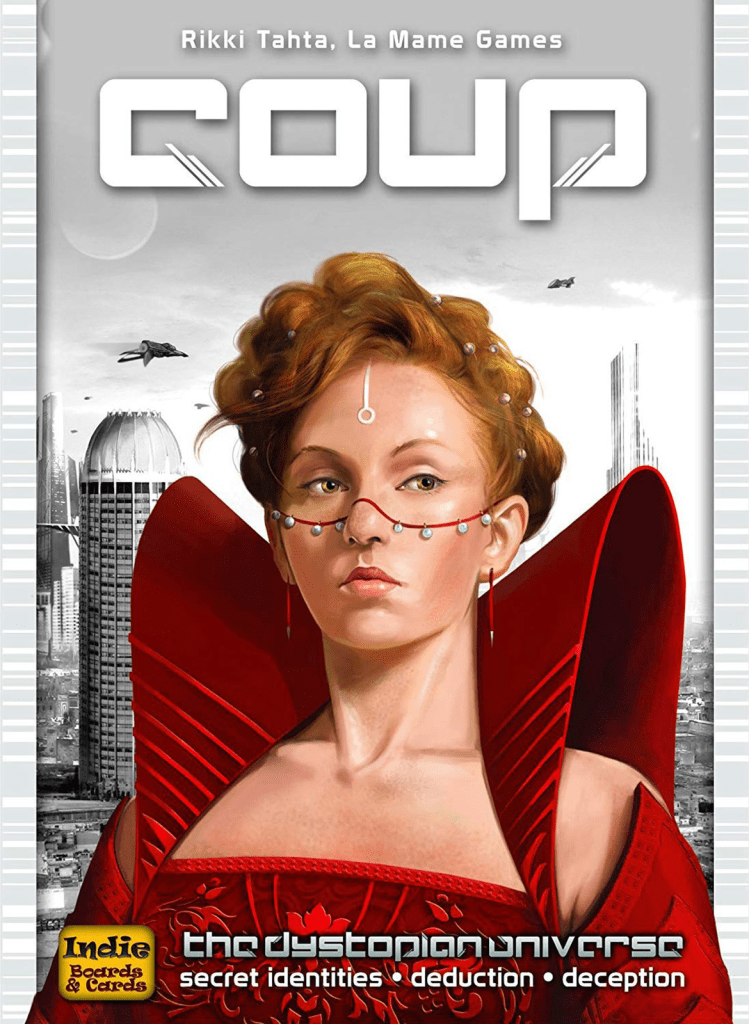
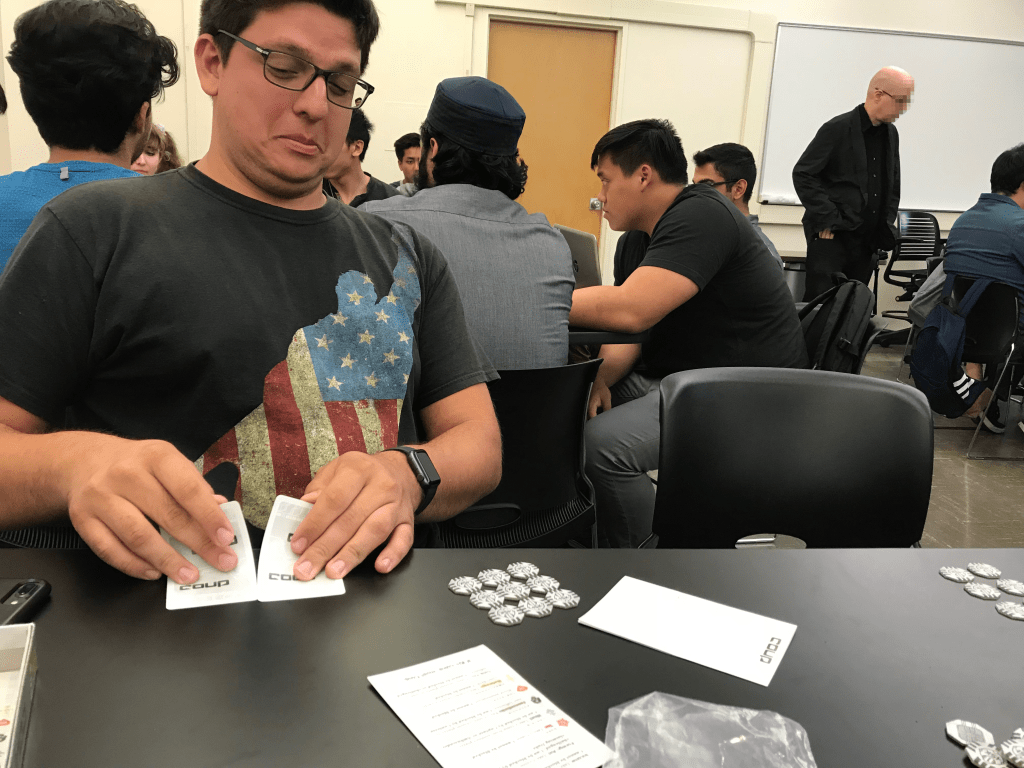
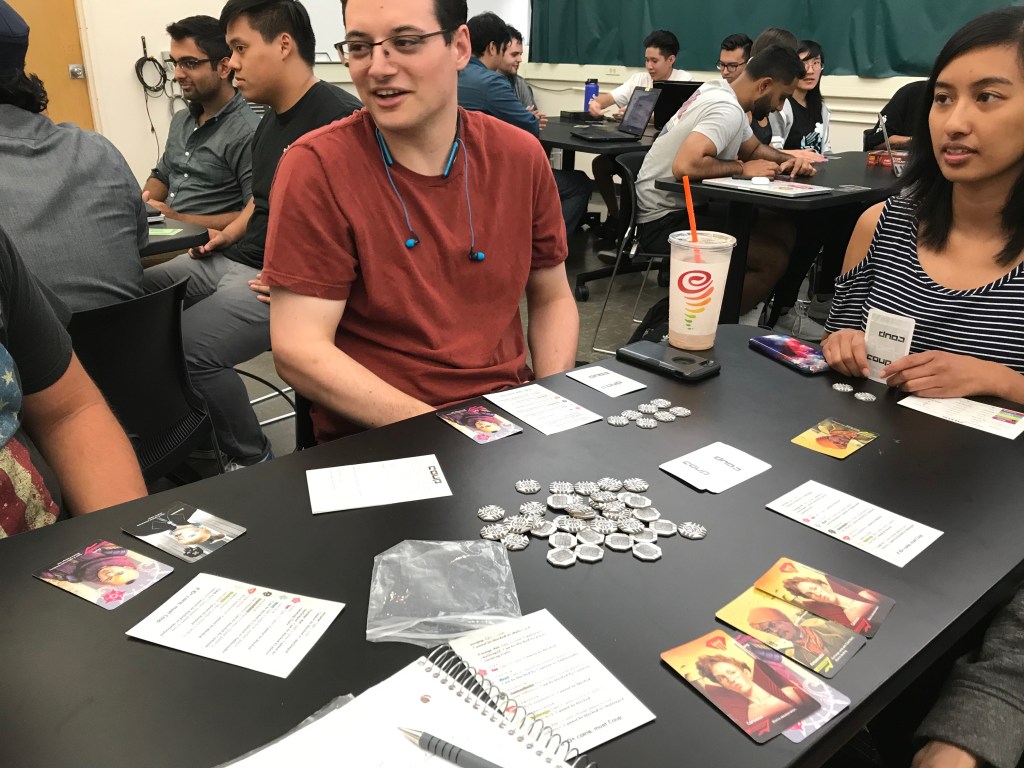
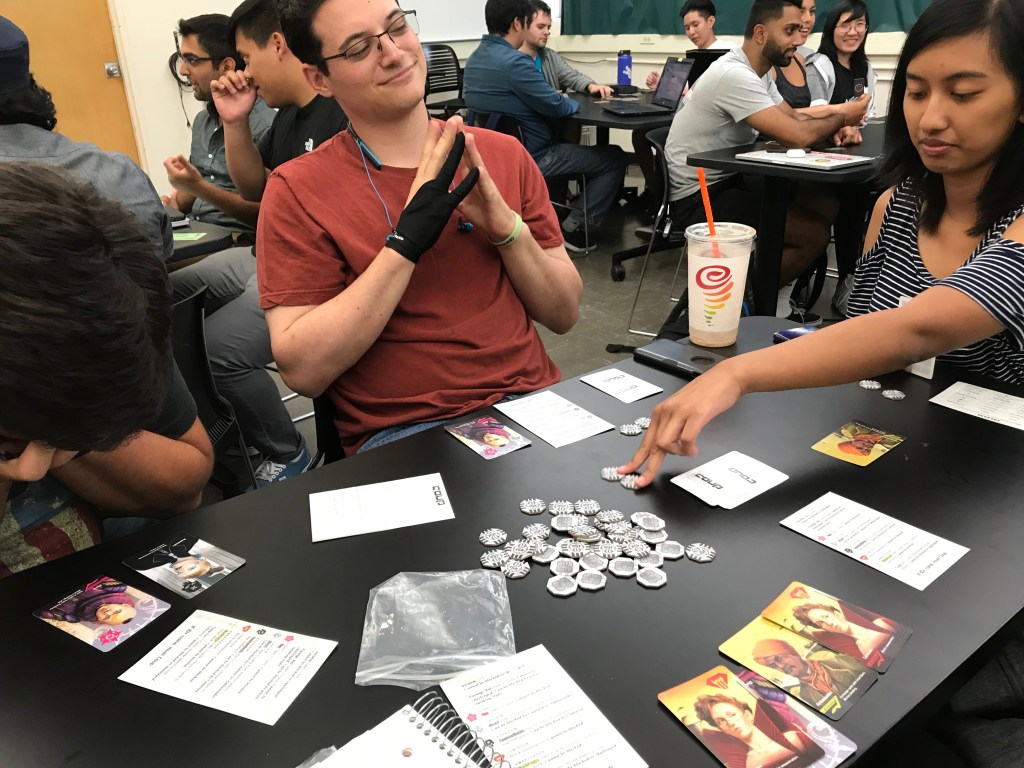
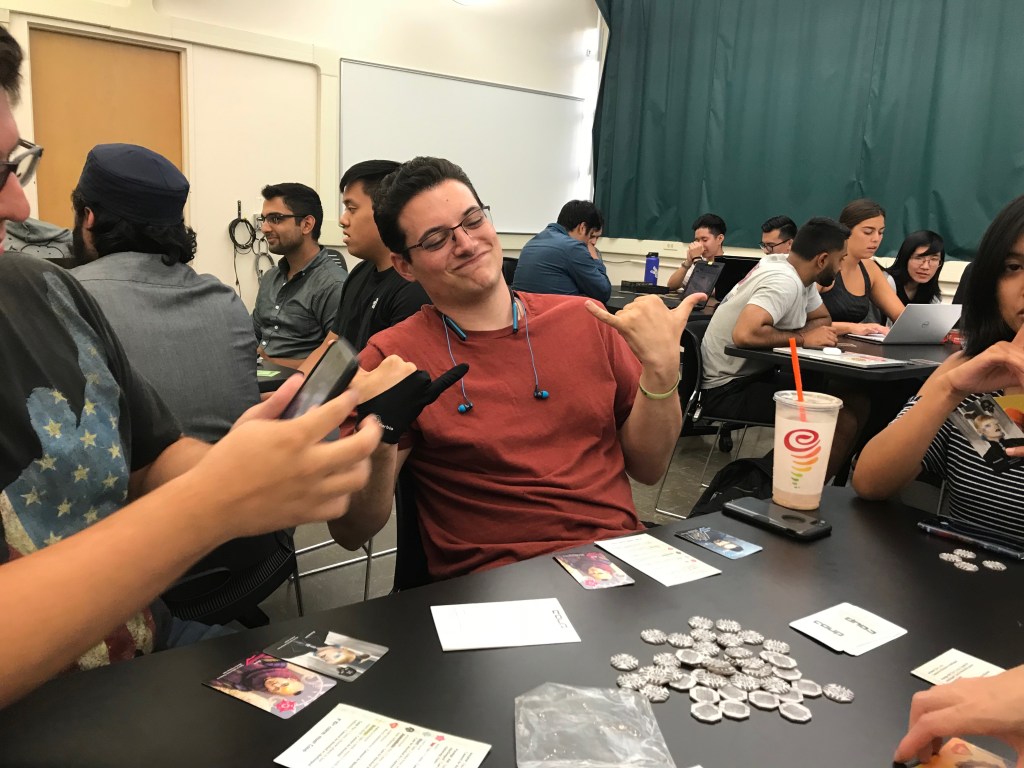
Coup is a card-based game about deception, deduction, and brutal defeat.

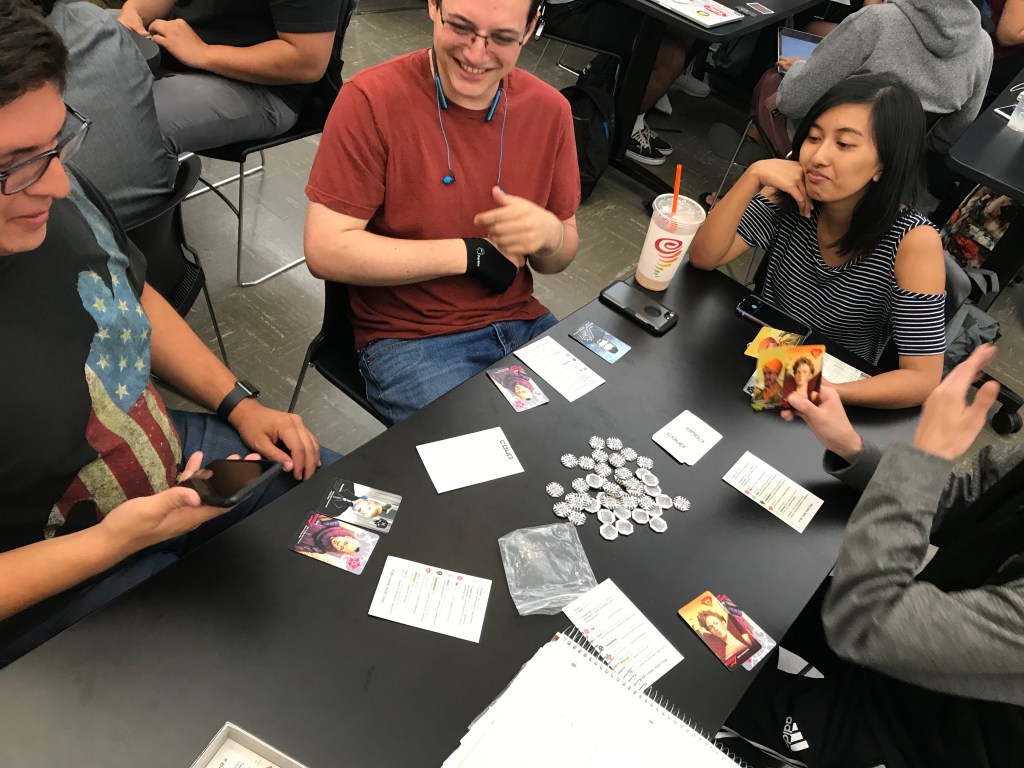
In class this week, we played board games. This is the first game we played, here is a link to it on boardgamegeek. The second game we played was Jenga, and it is interesting to note that we were playing a new in box original release copy from 1983. Here is a link to that game on boardgamegeek. This session report, however, is about the game Coup, because this was a new experience for me.

In a dystopian future civilization, 5 warlords simply could not live with each others’ presence anymore, and decided to kill each other in a game called Coup. These warlords were Derrick, Joseph, Clarisse, Leon, and Jacob.

Derrick claimed one of his two influence cards was a duke. He took 3 credits. Joseph did the same. But warlord Clarisse took 2 credits as foreign aid, which Derrick blocked, which was a rightful decision if he was telling the truth that he was a duke.

Leon made the claim that he had an Ambassador and took two influence cards and put two back. This made it unclear what his influencers were.

Duke Jacob took his 3 credits as a duke should, as did Derrick. But Joseph used his captain to take 2 credits from Derrick. Meanwhile, Clarisse and Leon each took one credit through normal means of income. Jacob and Derrick each took 3 credits as dukes.

Warlord Joseph was feeling bloodthirsty and got fed up that nobody had yet attacked, so he struck out at random, having enough credits to perform a coup. It was me, Jacob, that lost influence as a result. My duke was killed, in Joseph’s bloody coup. It was revealed that I was not lying about being a duke.

Clarisse and Leon, both did not want to become targets, so they took 1 credit each as normal income.

This time, it was Jacob’s turn to perform a coup as he had amassed at least 7 credits by now, and he retaliated against Warlord Joseph, and killed his duke in return. He was not lying.

Warlord Derrick did not want to kill his prey too early, he likes to toy with his victims. He performed a coup on Leon, who lost his Contessa, which meant he became vulnerable to assassination attempts. Joseph, still licking his wounds, took one income.

Clarisse, however, was wasting no time. She knew that Leon was vulnerable, so she assassinated Leon. Leon contested that she was lying, but she was not. Clarisse had an assassin as one of her influence cards. Warlord Leon was murdered. He lost all his influence. Jacob took one income.

Warlord Derrick claimed he had an ambassador as well as a duke and took two influence cards and put two back. Warlord Jacob was not sure of what Derrick’s previous cards were, and determined that he had been playing a little too safely. Jacob challenged Derrick that he was lying. But it turns out that Derrick was an ambassador, and Jacob lost his second influence card and was terminated.

Joseph attempted to take foreign aid, but was blocked by Derrick’s duke. Clarissa took one income, Derrick took 3 as a duke. Joseph, remembering his military prowess as a captain, took 2 from Derrick. Clarisse took one income, but was then quickly assassinated by Derrick, and she lost her ambassador.

Joseph took one income, Clarisse assassinated Derrick back, which he contested. But Clarisse did indeed have an assassin, which she had used earlier. “Curse my poor memory!” Derrick exclaimed! As Derrick lost both his influence cards, one for his failed contesting of Clarisse, and one for Clarisse’s assassination. Derrick was terminated.

Joseph was now free to take foreign aid, as there were no more dukes on the table. He got two credits. Clarisse did the same. Joseph took one income, not needing any more credits. Clarisse, was unaware that this was her last turn, she took 2 credits under foreign aid.

Joseph performed a coup on Clarisse and finished her off. Warlord Joseph had won.

All in all, it was fun. I’m sure it would have been more fun the 2nd or 3rd time playing, because it was everyone’s first time playing except for Derrick.

Design a site like this with WordPress.com
Get started