This week I played some simple free video games with a friend, Antony Bui. Some games of note that we played were “This is the Only Level,” “Don’t Shit Your Pants,” and “Salvation,” the last one being a student-made game.
This is the Only Level
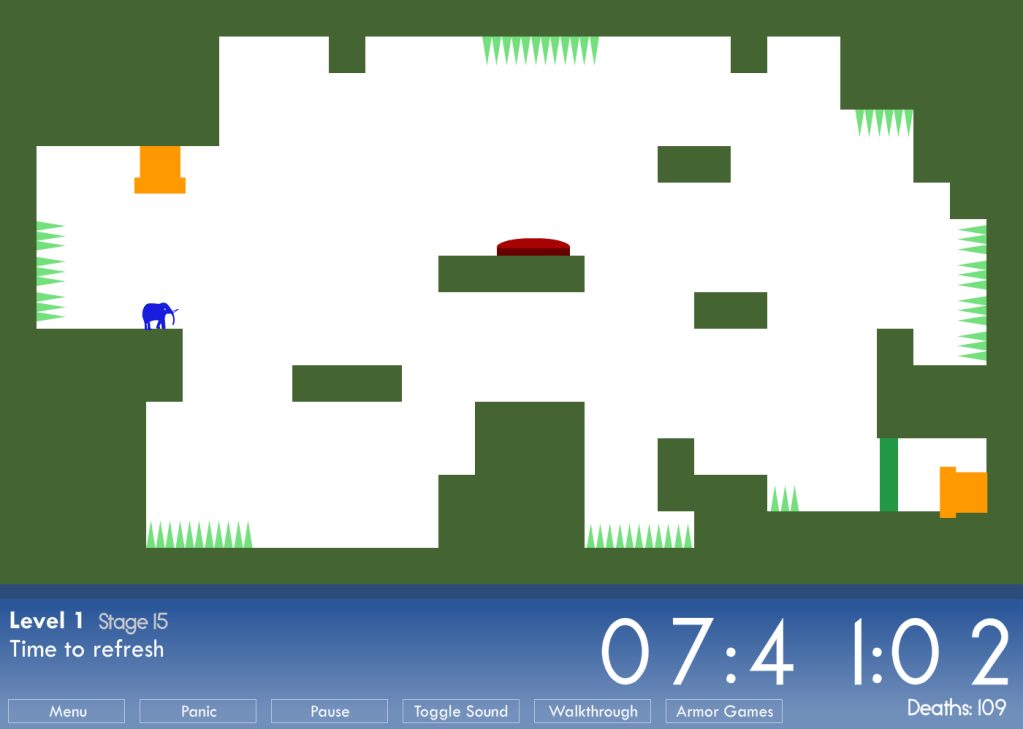
“This is the Only Level” was incredibly difficult because, while the traditional side-scrolling puzzle platforming level stayed the same with each pass, the control scheme and meaning of obstacles changed with each iteration.
Once you beat a few levels you began to learn what to expect, but the levels get brutally difficult after only a few levels have been beaten. Some of them place instant death tiles on the ground, which are easily avoided after dying once to them, but this is just the tip of the iceberg. The farthest we got was stage 15 where we could no longer figure out how to beat the level.
The variety was specifically mostly in the control scheme with a little in the elements of the environment. It seemed like it was designed to make the player to consider new ideas for games by making a lot of iterations on a classic format. It demonstrates that it is possible to deviate from the same game formats in infinitely many ways, so there is no excuse to keep making the same tired formats over and over again. I found it to be very instructive and incredibly thought-provoking, but I did not find it to be a very fun game. It was both frustrating and educational.
Don’t Shit Your Pants
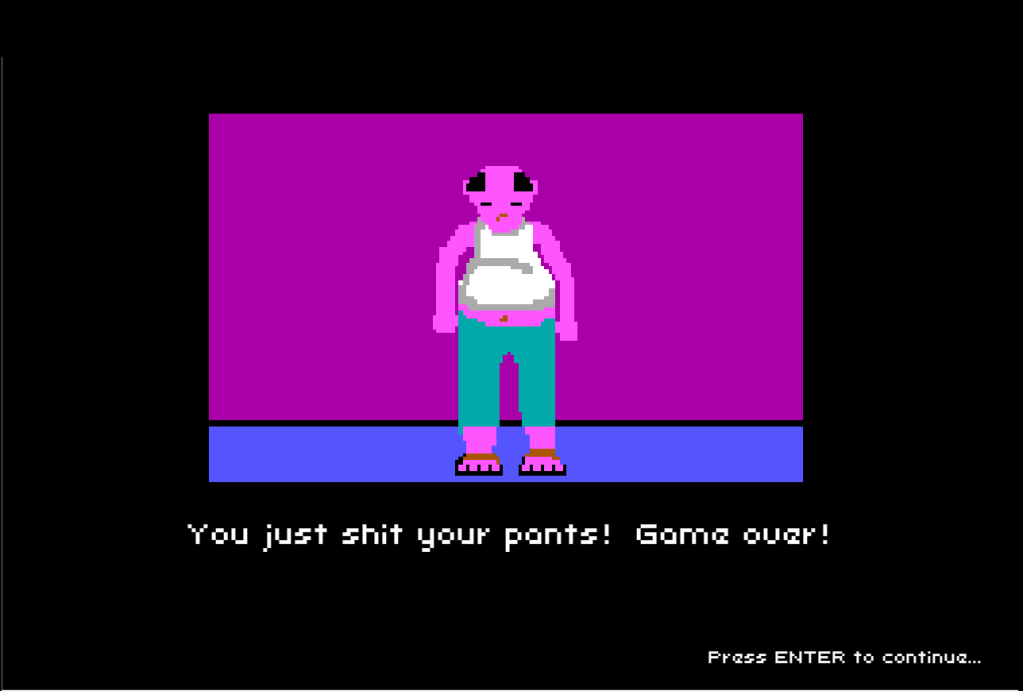
The next game of interest we played was “Don’t Shit Your Pants.” Maybe this is the 12 year old in me speaking but I found it to be both incredibly fun and incredibly funny. The concept is that you control a guy who is going to poo himself in 30 seconds and you have to type incredibly specific commands as in a text-based adventure like Zork, just to get him to open the door, pull down his pants, and squeeze out a turd that is coming in just a few seconds whether you’re ready or not.
The stakes are high, and failure is a reward in and of itself. There are achievements for finding each different outcome, which encourages jumping right back in for another fast paced attempt. For me the best part is how intricate it is. You can command him to poop in his pants simply by typing “shit.” You can command him to poo on the floor, fart to give yourself more time, take gas pills, or just watch as his eventual doom comes.
Having to figure out how to control him to do what you want, under a time limit, combined with exploring each and every thing you can do with immediate and sometimes devastating responses, and collectible achievements to mark what you’ve discovered makes this game actually sound very similar to “This is the Only Level” on paper. Why then is this game so much more fun?
There is virtually no connection with the mechanics of the two games. They are both played in entirely different ways. They also have completely different narratives. The objective and indeed the entire story of “This is the Only Level” is to get to the end. “Don’t Shit Your Pants” has a story and it has a vastly different tone than the other game. What then is similar about these two games?
The two games are both concerned with the same aesthetics. You go to these games to satisfy nearly the same itches. The games both feature a Challenge aesthetic where the game is an obstacle course with correct moves and incorrect moves. They also both feature the Discovery aesthetic, first in finding out if you really can poop his pants, and then discovering the control schemes of each one. You learn new ways of playing games, through trial and error and you have the satisfaction of having completed each one as a completely fresh experience.
Salvation
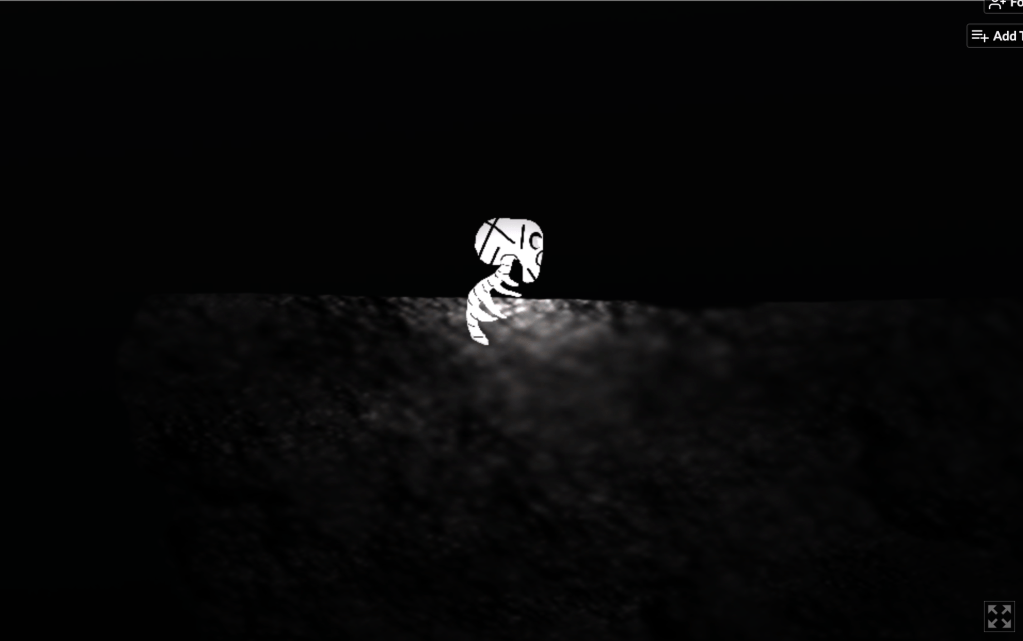
The last game of note that we played was “Salvation.” This one I watched him play first and then He watched me.
“Salvation” is a student-made game of the side-scrolling puzzle platformer genre. This game is actually very impressive for a student made game. It was probably made under a deadline and the student probably had to make some compromises on their original vision because of this, so I feel that is important to take into consideration when reviewing this game.
It suffers from a problem that a lot of side-scrolling games have. Your character can outrun the screen. This is especially true when jumping. The problem is exacerbated by the fact that enemies kill you in one hit. So if your character is all the way to the right of the screen, you can’t see a monster coming and you will sometimes die right away without knowing what happened, unless you’ve played the level before and have memorized the position of the enemies.
Watching Antony play, I kept wondering why he was jumping in a specific way, or why he chose to jump so fast off screen. Playing myself, I found that these were not choices. It was actually very hard to avoid going off screen. I also wondered why he couldn’t juke the enemies and outrun them, but when I played I found that they stick to your character like glue. I just kept saying in my head, “I could have made that jump better” or “I could have seen that coming and avoided that.” But when I played I found I was falling into the same traps and making the same mistakes.
I suppose that means that the difference is that, as a watcher, you can take in more of the details since you don’t have to worry about survival. As a player, your mindset is different. You are just trying to survive and find the end of the puzzle.

