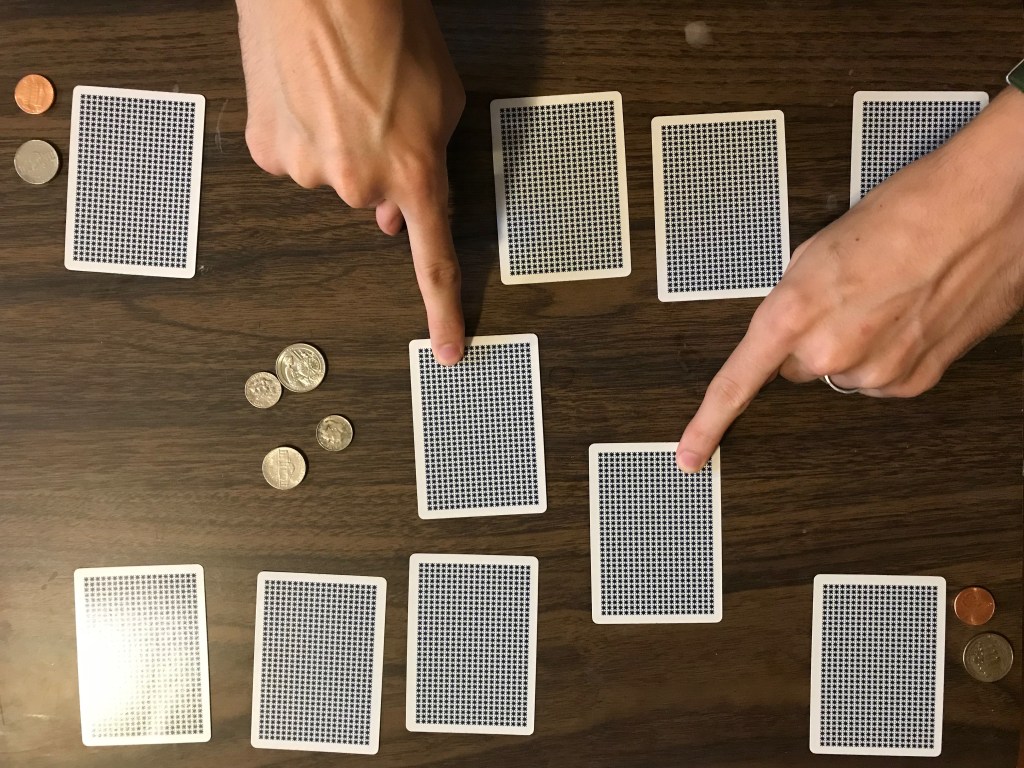
Two weeks ago, I was inspired to create a card game. I joined with another enthusiastic student who wishes to make games and we set to work. Afterwards, we split up to take the game in completely different directions.
My take on it is called Scunch simply because it’s fun to say.
The game is a take on Poker by somebody who doesn’t like playing Poker, but does like friendly competition between friends. It is typically played by two people, though it can be upgraded to four.
How is it supposed to play?
First, each player pays the ante, one Ante Token (commonly, one penny), into the pot, this is the wager that you are going to win. Then, from a standard shuffled deck, each player is dealt 3 cards whose positions on the table do not change, unless a player makes a move.
This is the core mechanic. Players choose a card to trade with a card from their opponent’s hand, in order to learn what cards are in play, so that they may make their hand better by the end of the final round. Once both players have made a move, then the round is over and a new card is dealt to each player’s hand.
Once the second round is over, a fifth card is dealt, for the final round. Once 3 rounds have completed, players reveal their hands, and Poker rules dictate which hand wins the pot.
Instead of betting as in normal poker, the players may wager larger value tokens to perform special actions in the place of their trade move. The Sight Token (commonly a nickel) is wagered and the player may see an opponent’s card without trading. The Shuffle Token (a nickel) is wagered to shuffle your hand so that your opponent may forget the positions of your cards. And the Discard Token (a quarter) is used to remove either yours or your opponent’s card from play, to be replaced from the deck.
Scunch is also pretty fun when played with all 5 cards dealt right away and only the Shuffle and Discard Tokens in play. This is called Scunch Lite.
But how has it been played?
Scunch Lite is the original form the game took. When I played with my co-creator, we started it like this:
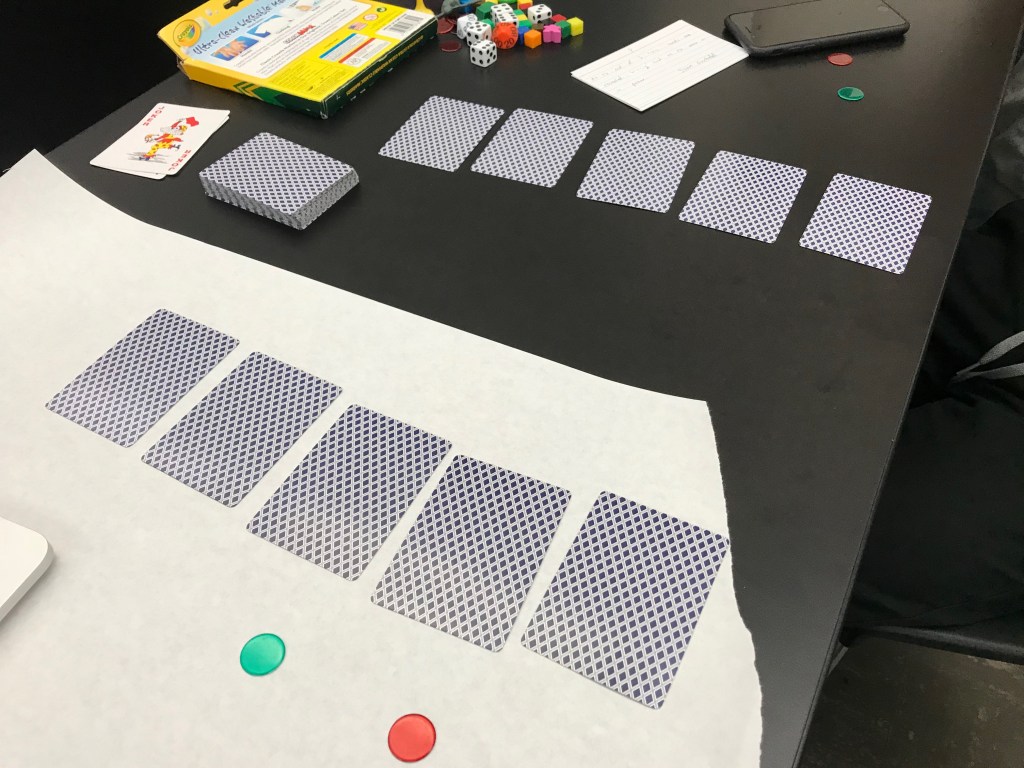
Both players were dealt 5 cards face down and given a discard token and a shuffle token. We looked at our cards and returned them to their original positions. I was dealt a K, 7, 9, A, and 10, my opponent was dealt a 7, Q, A, 4, and a second 7. I went first and I traded my 7 for his A. Now I know one card of her hand and he knows one card of mine. His turn, he traded a 4 for my 10, and we know 2 cards in each others’ hand and round 1 is over.
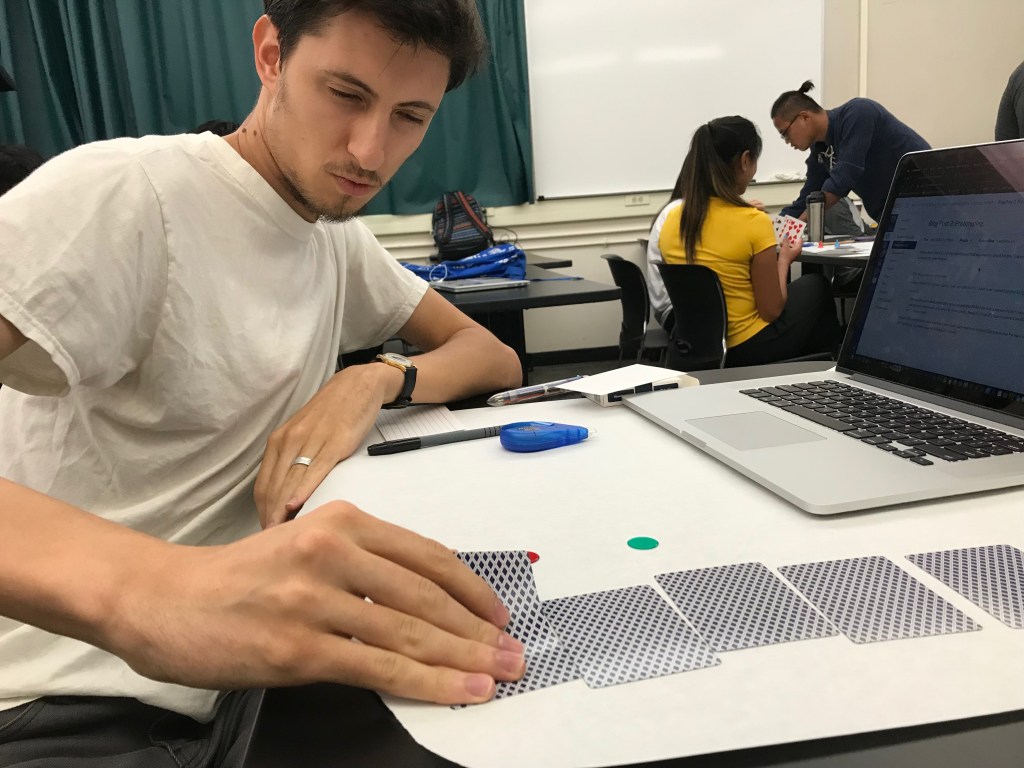
Round 2: Next I traded the 4 I was given for his Q. He gave me back the 4, and he took my K.
Round 3: I spent my Discard Token to discard one of my own cards (the white elephant 4), and I got a 2 in return which doesn’t help me. He traded my 10 back for the A he had given me.
Reveal! He had 3 of a kind, and took my A at the last second so I didn’t have a pair anymore. A crushing defeat!
We were enthralled! We both loved the game we had created right away, even though I had lost, I was thirsty for more. I knew what hands I needed, and I felt like I could build them with the knowledge I was getting.
Scunch Version 2:
This version, I decided to morph the rules slightly to incorporate an additional Token, the Sight Token. This would allow players to learn an opponent’s card without giving them knowledge of one of your cards. But, since it is guaranteed this token will be used right away, I also added an additional Round.
I played this with a fellow game creator in class on Friday and it played out like this.
I was dealt a J, K, 9, 3, 10. My opponent was dealt a 9, J, 4, 5, 4. Round 1: My opponent went first spent their Sight Token to see my 10. I did the same and saw his J.
Round 2: My opponent traded their 5 for my 10, knowing that it was there, and I, knowing where his Jack was, traded my 3 for it.
Round 3: My opponent traded back the 10 for my 5. My turn, I spent my Discard Token to discard his 5 since it seemed he wanted it, and he was given a 5 again from the deck, which I did not know at the time.
Round 4: My opponent traded his 9 for my K, I spent my shuffle Token to essentially skip my turn because I didn’t want to change my hand.
Reveal! I won this time, I had a pair of 9s and a pair of Js, my opponent was going for a strait and did not get it, but his pair of 4s was beaten.
I had a little bit less fun with this one since I was having a bit more trouble remembering the cards and how many rounds had been completed.
Scunch Final Version
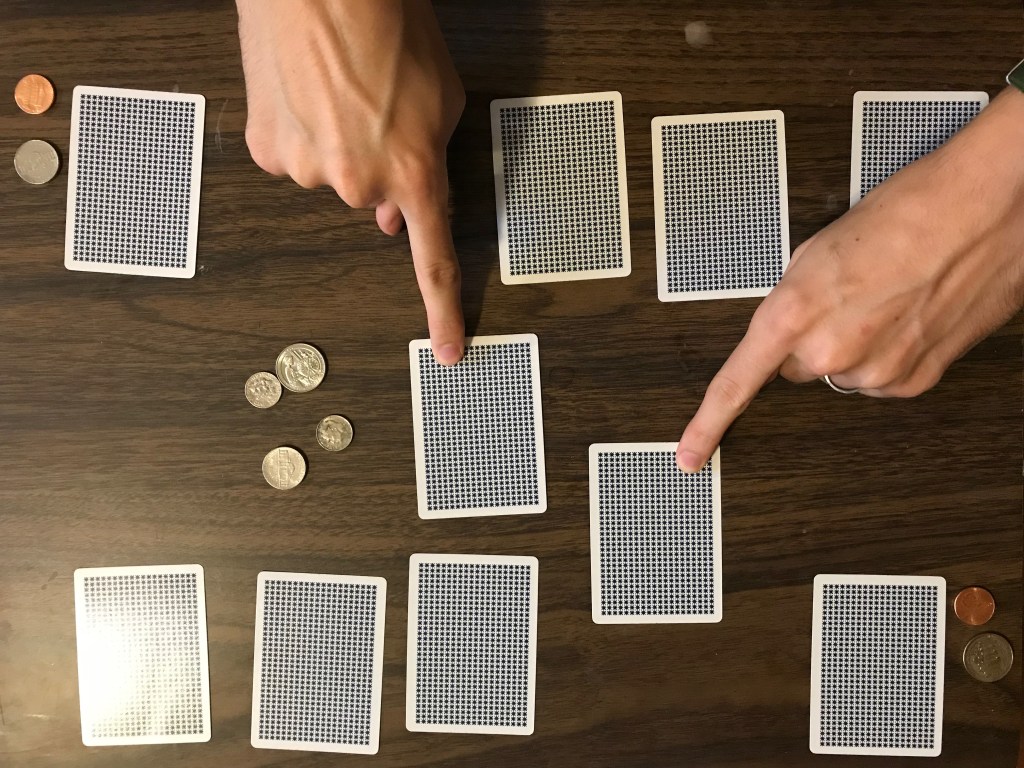
After much deliberation, I decided that more than 3 turns became too much to remember for the average person, so I trimmed it down to 3 again and kept the Sight Token, but incorporated another aspect of Texas Hold’em. I decided to deal out 3 cards right away, and deal two more both as a way to ease players into the memory aspect and to mark the rounds. And with the first round meaning less, we didn’t mind if it was used primarily on a Sight Token. And I decided the game would be more interesting if the Tokens functioned as bets as well, which gave incentive to wager Tokens wisely, instead of spend them all in one game.
We both paid the Ante with our Ante Tokens. I was dealt an A, a 3, and a 7, and my opponent was dealt a 3, 2, 2. I went first and I traded my 7 for his 2. His turn, he traded me back the 7 for my 3. I was dealt a 5, and my opponent was dealt an A.
Round 2: I trade my 5 for his new card, the A. He traded the 5 for the 2 back.
Round 3: I was dealt a 5, and my opponent was dealt a 6. I spent my Discard Token to discard my 7 and I got a 3. My opponent traded a 6 for my 3.
Reveal! I had 2 pair, A, 6, 5, A, 5, and my opponent had a full house! 2, 3, 2, 3, 3. My opponent won the Discard Token I wagered as well as the two Ante Tokens.
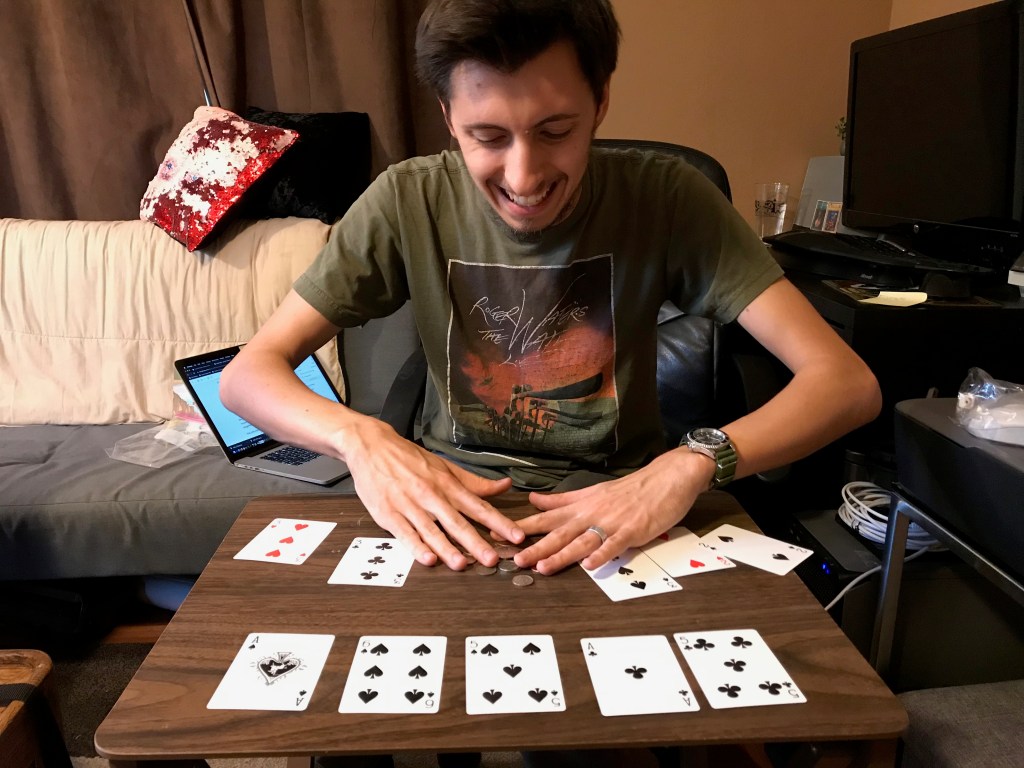
This one works. This one has the most potential for strategy.
 Jacob's Game Dev Course Blog